When Planets Align

I don’t know much about astrology. And I certainly don’t want to be pigeonholed as someone who’s “into” astrology. Unfortunately, the study of how the alignment of stars and planets interacts with human rhythms and endeavors has been written off as “woo-woo” and “airy-fairy”. Yet, I have tried to pay attention to what data an astrological approach might offer my attempts to understand and powerfully engage with my destiny. I have less interest in daily predictions than I do the broad strokes of what I might need to pay attention to in the span of a year or an epoch. 

I started to become interested in astrology a few years ago when I read my yearly horoscope at the end of the year – and saw how eerily some of the surprising occurrences throughout the year were nearly predicted by my chart. I looked at my horoscope for the first time when a friend suggested I had entered my “Saturn Return”, in response to my sharing that I was going through a particularly rough time. The idea, for those unfamiliar, is that the planet Saturn is at the same place at age 27 that it was at our birth. For some, it is a time of dramatic upheaval, lasting until age 32. Sure enough, my life was thrust into chaotic transformation at the moment of my 27th birthday and everything was (more or less) calm and settled by the time I turned 33.

Since that epiphany that astrology might offer an increased ability to make sense of seemingly random occurrences, I have sought the advice of my horoscope every year. I appreciate the writing of self-proclaimed Visionary Activist Astrologist Caroline Casey on the topic, who advises that we “Believe nothing, entertain possibilities” and “create prophecy” rather than “live prediction,” for predictions make us passive while prophecy is “active co-creation with the divine”. As a community-oriented depth psychologist, I study culture, myth, and archetype – and since astrology weaves together these factors of psyche, I consider it necessary to at least be familiar with, if not consult, the information that astrology makes available. 

With that said, I get that people are cynical about what appears to be pseudo-science. Some are even angry that astrologers didn’t predict the coronavirus and its global impact on humanity. But astrologers simply interpret charts, and without a context of coronavirus, it wouldn’t necessarily show up. The particular perspective that an astrologer takes on a chart is vastly colored by what they’re looking for. In hindsight, however, one can gain some insight from the planets around our current pandemic. According to Susan Miller’s article on March 16: 

“this crisis is brought to you by Pluto, a powerful planet that deals with huge financial matters, masses of people—and viruses,” while it’s conjunction with “Jupiter amplifies what Pluto reveals and wants to multiply, and few planets can multiply anything it touches faster than Jupiter.”

And:

“What makes this year’s orbit of Jupiter and Pluto different is that Saturn, the planet of karma, will orbit with them both all year in a highly unusual three-some tight orbit. The scientists say that our misuse of the earth’s resources and lack of proper stewardship of our planet have led to an imbalance that encourages deadly viruses to surface.”

From Casey’s Visionary Activist approach to astrology, it is evident that we might not depend on astrology to predict worldly occurrences, but we can turn to astrological interpretations to illuminate patterns and to offer increased meaning and understanding when there might otherwise be little method to apparent madness. 

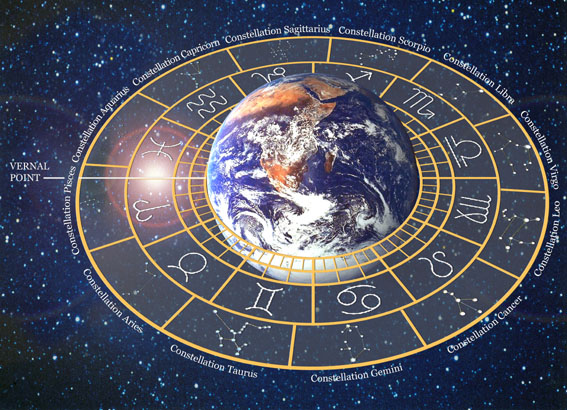
While I am curious about astrologers’ interpretations of the current times, my interest is more centered on the vast transitions occurring over centuries – which brings me to the Age of Aquarius. People might be most familiar with this concept through the cheesy song in the play Hair. While there might therefore be an association in popular culture between the Age of Aquarius and the “Hippy Era” of the ‘60’s and ‘70’s, astrological experts suggest that the ages of the zodiac last approximately 2000 years. So while this era may have been popularized in the middle of the last century by a rock opera, astrologers offer differing opinions about its initiation: some say it won’t begin for another millennium while others suggest that it already started a few centuries ago. The fact of the matter is that when we’re dealing in the span of millennia, a few hundred years is quite arbitrary. 

The reason that my thinking is centered on the Aquarian Age is the way that the coronavirus appears to be more of a harbinger for this transformative time period. Casey, in her book Making the Gods Work for You, described Aquarius as being characterized by innovation, information, change, technology and communication. While these elements have been growing over the last century or two, the internet, in general, and social media, more specifically, are distinct properties of Aquarius. 

Additionally, and especially pertinent to the current pandemic, Casey wrote that “Aquarius knows that we are all united through the air that we breathe”. Despite the catastrophe of this moment, we have been connecting more across greater geographical expanses through virtual tools like Zoom – and (hopefully) we have become more present to our shared human fate in the acute realization that airborne toxins affect us all. Although it will be some time before we are on the other side of the drastic societal trauma caused by this virus, perhaps it is also working to propel us further into the Aquarian epoch of interconnectedness – in our global reach and our increased empathy for those near and far. 

Passover, Liminality, and the Present

The 8-day Jewish holiday of Passover is almost over. I’ve spent much of this time reflecting…and mulling over what to write below. Of course, everything is tinged these days with the coronavirus. Although it may be cliché, this article will be too, a little. I’ve heard many people from the Jewish world talk about the “plague” of the coronavirus. (For those unfamiliar with the Exodus story, there are 10 Plagues that fall on the Egyptians. Watch the movie Prince of Egypt). One rabbi even asserted that the coronavirus is NOT a plague, ostensibly differentiating something that is man-made from the divine miracles of old. I didn’t buy his argument. I think the metaphor is worth playing with. But that’s not my focus here. Rather, I’m interested in the liminality, which I’ll define below, that characterizes both Passover and our current time period.

One of the well-known parts of the Exodus story is when Moses sees the burning bush and speaks to G-d for the first time. He is told, “remove your shoes from your feet, for the place you stand is holy ground” (Exodus 3:5). Standing barefoot in the shadow of the numinous might be a logical response of humility and connection. This gesture is also a great instance of what Thomas Moore calls temenos, ancient Greek for marking a special place or precinct for the sacred. Perhaps taking off one’s shoes is one way to mark a threshold.

There is another meaning to this famous phrase, however. I recently shared this passage with the 8th graders I’m teaching (by Zoom, of course); they were struck by the multiple meanings of words in the Hebrew lexicon (oftentimes because the Hebrew from the Torah is missing vowels, leaving the exact translation open to interpretation). As I’ve learned from Rabbi Zelig Golden of Wilderness Torah, the phrase “remove your shoes” also means “remove your locks” and “from your feet” can alternately be translated as “from your habits”. So G-d might be telling Moses to “remove your locks from your habits”.

This is exactly what Moses must do.

Moses had already spent the last few decades in the desert of Midian, far from the Egypt of his upbringing. The habits he developed as an adopted child of Egyptian royalty had long been exchanged for the rhythms of sheepherding, raising a family, and learning the wise indigenous ways of his father-in-law Yitro. But the self that he had become during this time period was no longer sufficient for the leader he would need to be. Although his robe and staff may have continued from his sheepherding days, he would ultimately have to transform himself prior to his eventual triumph in liberating his fellow slaves.

Not only would Moses have to continually “take off the locks from his habits” as he led the mixed multitudes in the exodus from Egypt (perhaps what he was doing on Mount Sinai for forty days), but throughout their wandering in the desert these people must do the same. For forty years, people who were socialized into slavery and complicity must re-learn freedom, including its particular encumbrances. Many in exile complained to Moses about not having access to the luxuries they did as slaves. These people did not make it. They needed to be liberated not only physically but psychologically, prior to entering the Promised Land. Their descendants who were born free would get to start a new society free of shackles.

Every Passover, I try to use the journey from Mitzrayim – Egypt – to Freedom to process my own mitzrayim, translated as: “narrow places,” “constraints,” “tightness”. I look throughout the eight days for any last chametz (leavening) to slough off. In order to be truly light; to be free. The eight days of Passover might be thought of as what Victor Turner called a “liminal space,” which C. Michael Smith (Jung and Shamanism in Dialogue) defined as a “space/time pod in which the individual is ritually unbound from the binding power of social norms and conventions”. The concept of liminality is perhaps Turner’s greatest contribution to the study of liberatory pedagogy.

We might imagine that what Moses endured as he was transformed from shepherd to prophet was, as Smith explained liminality, an experience where “previous cognitive and psychological structures are deconstructed and reconstructed as they come into contact with the powerful transformative energies of the sacred”. The liminal space of the desert is a necessary vacuum in which transformation might occur. This has been experienced viscerally by those who join Wilderness Torah at Passover in the Desert during the holiday – an event which was sadly not possible this year.

Which brings me back to the coronavirus – or rather the surprising confluence of impacts on our society as a result of being unprepared for the virus (I’d rather not collapse all of the dynamics occurring right now with the pandemic itself). This confluence is resulting in, as I wrote about just a few weeks ago – and you’ll surely recognize, a palpable slowing down and spaciousness for many of us. [ I would imagine that there is some other tone of liminal space for healthcare workers and service employees, not to mention those who become ill – albeit much more intense and a lot less pleasant than day-drinking or universal home-schooling. Therefore, a cautionary note: my writing here might not apply to every individual. Rather, I am interested in looking at the broad strokes.] The point of a liminal space is that it is markedly different from the “old normal”. It is also not yet the “new normal”. It is betwixt and between.

We have yet to see how we show up on the other side.

Liminal space is often used in the context of initiation processes. Perhaps we are being initiated into a new way of being. Of course, this depends on to what extent our society is able to integrate the lessons from this time – a demand that initiatory processes always impose. Regardless, there is work to be done. For those of us who are God-wrestlers (the original meaning of “Israel”), this is an opportunity to clear one’s home of crumbs that do not belong. And for all of us trying to survive amidst the pandemic epoch, there is a possibility of getting down to the essence of what this time is trying to teach us.

Passover will soon be over. While I’ve spent the last week avoiding pizza and donuts, I will soon be able to eat those things once again. Savoring leavened foods after Passover will be better than it was before, for going without accentuates the pleasure of having. Yet it is my responsibility to remember the “bread of affliction” that I ate this week, the cracker whose fragility mimics the real fragility of our freedoms. Eventually, post-coronavirus, we will begin to go to restaurants again, to get our hair done, and to hug our friends. It will be an incredible joy. Until we become complacent again, with the “new normal” just becoming normal. We’ll have to intentionally expend effort to remember what it was like in quarantine – or mitzrayim, those tight places of constriction that limit us. To really be able to savor the joy of our most taken-for-granted luxuries. Baruch haShem/insh’Allah/G-d-willing, the sacrifices being made now will be worth the promise on the other side. 

Forced Sabbath

I’ve been thinking, since St. Patrick’s Day, about the element intrinsic to a day like that – Cinco de Mayo, as well – of cultural appropriation. I rarely eat meat, but leading up to St. Patrick’s Day, I’ll look for a free-range/organic option of a nice piece of corned beef – and a couple cans of Guinness. A few years ago, I was vegan and my first (surprise!) meat meal was when my partner’s father – who never otherwise cooked, and has since left the world of the living – made an amazing pot of corned beef and cabbage!

I am right to be skeptical of celebrating in this way – I have no Irish ancestry that I know of. So why am I celebrating? Is this appropriate? Do Irish folks mind? Where should I draw the line?

So I started thinking: what would I think and how would I feel if people far and wide started copying a holiday from Jewish practice, my primary ethnic identity? Would I want a bunch of people eating matzah and drinking four cups of wine for Passover? Maybe. How about lighting candles and making latkes on Hanukah? Mmmm…not sure. How about spending a full day in a process of teshuvah – repentance and return? Well, yes, that’d be great – and I believe that the Landmark Forum is an incredible secular version of Yom Kippur! (A conversation for another time, perhaps.) And then I thought: would I want everyone to take a day of rest? Ding ding ding! A day away from driving, texting, and needing to produce. YES! We should all do that.

Wayne Muller wrote a beautiful book called Sabbath, where he asserts the “necessary wisdom of dormancy” – an opportunity to “lie fallow, and restore our souls”. Taken to the extreme, if we do not structure into our lives some time for reflection and holiness, and operate solely from a constant doing and reacting, then we are liable to make all sorts of mistakes with echoing impacts on society. As I have implemented a Sabbath practice in my life, I have seen how it creates space for me to refresh and renew – as opposed to the harried hustle that is the default in our society. (This is not to say that Orthodox Jewish practices of Shabbat are perfect. Oftentimes, people forget the essence of keeping this day sacred, and instead make it as stressful as the rest of the week!)

Over the years, I have sought to discover what a Sabbath practice looks like that truly honors restfulness. I won’t work or usually use technology, and I love sitting on my balcony and reading. I have also  learned how my Sabbath practice influences my wellness. I can tell that I start to get colds when I have not intentionally taken moments to breathe in my week. Muller also wrote: “If we do not allow for a rhythm of rest in our overly busy lives, illness becomes our Sabbath – our pneumonia, our cancer, our heart attack, our accidents create Sabbath for us”. This is not, however, to moralize: “See – you didn’t take Sabbath seriously so you got sick!” Rather, as a depth psychologist, I look at symptoms as symbols which point to greater dis-ease or mis-alignment hiding more deeply under the surface.

This seems to be the bittersweet gift underlying our current environment of social distancing. Although a vibrant Sabbath practice would most surely involve connecting with community – and certainly not a race to the bottom search for toilet paper! – our whole society is getting a moment to settle. I believe that our winter months are meant for a social hibernation – a slowing and slumbering and maybe even sloughing. But, as a society, we fight that seasonal impulse – rushing around, endless parties, constant buying. If the gods require of us some going inward, then they have been left wanting. Therefore, dis-ease comes to force us into a reflective posture. It is our job to utilize this time thusly – to learn how to slow down and breathe – a capacity which, as coronavirus is reminding us, is incredibly precious.

I do not mean to make light of the wrath caused by this pandemic. I am speaking from a place of privilege – where I can talk about large societal trends, unfocused on any particular people that I know who are suffering. The ability to take time away from the marketplace requires a social safety net and alignment with financial structures that is not currently in place. While the likelihood is that the government temporarily bails us out (but mostly just helps the 1%), and we then go back to our pre-COVID-19 ways, there is potential for a lesson in all of this.

I believe that part of our work to do, if we are to arrive on the other side of this epoch with full benefit, is not just to avoid contagion. It is to learn to hibernate and cuddle – with a significant other or ourselves. It is to slow, to take easy, in stride. That is not to be taken lightly. As Lynn Ungar wrote in the poem “Pandemic,” which I’m glad has recently been getting around:

What if you thought of it as the Jews consider the Sabbath— the most sacred of times? Cease from travel. Cease from buying and selling. Give up, just for now, on trying to make the world different than it is. Sing. Pray. Touch only those to whom you commit your life. Center down.

We have the ability to choose what context we place around life’s occurrences. Clearly, the default context of a global pandemic is pandemonium. We’ve seen that already. More doing. It’s not inspiring and it doesn’t get us anywhere. What I think is just as present is the hibernation we’re all doing – the moving into ourselves to renew and reflect, so that we might arrive on the other side with newfound wisdom and purpose. It is a form of work: learning how to restructure routines. As in meditation practice, constantly coming back to our breath. To just be. And the world is calling on us right now – to take on this invaluable mixture of labor and rest. A contribution to the divine, just like our ancestors would have wished.  

Positional // Relational

Today, when I got home, I was a little pissy. A little disappointed, exhausted, and “up to here”. I acknowledge to my partner of nearly 12 years that I was being snippy and apologized. Back in the day, it would have started a fight between us. Thankfully, over the years we have developed the tools to process our emotions. We can relate to Shakespeare’s guard in Romeo and Juliet, who says “I do not bite my thumb at you, sir, but I bite my thumb, sir” – I’m being snippy because I’m being snippy; don’t take it personal. And I’m sorry.

As I was processing my feelings, I expressed to my partner how I felt like I didn’t have much extra space for conversation because of the toxic nature of my day. Even as the words came out of my mouth, I was unclear what exactly was toxic. I spent the day sitting in a government hearing, from 9am to almost 3pm, as a plethora of stakeholders plead to 10 appointed officials as those officials deliberated a fee on diesel trucks at the port, in order to reduce emissions and improve air quality.

I was hired three months ago to do community engagement near the port communities of Long Beach and San Pedro. Today, as far as I know, was the last day of the campaign. Perhaps some of my stress and discomfort at the end of the day was a result of not knowing what’s next for my work. But I believe that what was toxic was the energy it took for me to withstand all of the “positionality” I experienced. As someone trained in the ontological lineage of Werner Erhard, I will explain what I mean using quote about Werner’s theory of self from his biography:

“Identity as fixed identification is seen as a liability: the more fixed one’s identity, the less experience of which one is capable. The point is not to lack a position, but not to be positional: not to be attached or committed to whatever position one does have at any particular moment. One is – one experiences ‘aliveness’ – to the extent to which one can transcend particular positions and can assume other viewpoints; to the extent to which one can create and be the space for other viewpoints to exist”.

I have gained the skills, over the years, to be space for other viewpoints. I have participated in two organizations or communities – both of which I discussed in depth in my dissertation – that prioritize being relational. I am used to being in large groups of people during which – at some point, if not multiple times – there is conversation between those one might not otherwise talk to. I truly know the power of what is possible when diverse collectives come together, sharing what they each care about and the capacity to do something about it.

At the port today, every single group had their own position on a very specific matter regarding this diesel truck fee. Port staff: “We recommend a $10/cargo fee”. Trucking association: “Over my dead body”. International Longshore and Warehouse Union: “We agree to $10 and not a penny more!” Environmental health organization: “We want a $50 fee. A human life is worth more than $10!” Environmental justice organization: “Yes, higher fees – but also no support for natural gas!” Truck-driver union: “We want clean air but don’t want this fee to fall on us, as the corporations usually allow it to!”

The irony – talking about reducing pollution, but creating their own toxicity.

These figures never speak to each other. Each sits in their own aisle in the auditorium, each with his or her own particularist wardrobe: suits, union logos and neon vests, “Breathe Easy” t’s. They each say that they want what’s best for the community – and many pay lip service to their willingness to work with each other. But that never happens. Throughout this campaign, I tried persistently to meet with other social justice organizations to ensure that we were aligned and collaborating. I could never get a response. Members of the various unions involved, despite idealistic pretensions to solidarity, won’t speak to each other.

I am discovering more and more that I am a bridge builder and a weaver of community tapestry. This might sound warm and fuzzy; but, ultimately, I believe, that is how you get things done. I have been able to connect with a wide variety of stakeholders doing all sorts of interesting community change efforts around the ports. With a little more time and experimentation, connecting them and breaking past relational obstacles could result in some transformative results.

The organization I am working for is interested in finding people to give public comment at meetings – people who will toe our line and speak out. This focus stands in stark contrast to my instincts as a community organizer. I am looking for people who are relational: leaders who have relationships in community; who are willing to share themselves, develop themselves, expand themselves. I want people who are willing to compromise and be agile.

Our world tends to be pretty polarized. Eitan Hersh has written about “political hobbyism,” the tendency for people in our modern era to treat politics like they do sports – with the same vitriol and competitiveness, as well. It’s easy to simply know that and go on with one’s day. Yet, to be in a room for 6 hours, witnessing all of the various voices, taking a stand, can be training. I don’t believe we should never take sides. As a matter of fact, there are many social justice issues where we must polarize; where we MUST take sides. And then there are issues where we must work together.

Either way, I believe that for us to achieve the results that we need, considering our current crises, we must learn how to be relational. We must practice the art of listening. We must learn how to develop what the broad-based organizing tradition calls relational self-interest, a deep understanding of what matters to others who are different from myself. And we must learn how to make ourselves agile – not brittle or obtuse, but willing to mold a created future together with others. We must detoxify not only our air but our social structures, as well. We must become relational versus positional.

Educated Fools

(This video contains the Damian Marley song “Educated Fools” which inspired this article)

Today, I was sitting at a conference, and I couldn’t stop thinking of this song from Damian Marley’s Halfway Tree: “Educated Fools” (feat. Treach, Bounty Killer, and Bunny Wailer). I spent the day with a relatively progressive group of individuals, the majority of whom works for bureaucratic entities related to environmental regulation. It turns out that Environmental Justice has been (by and large) co-opted by the establishment. They were all impressively educated: PhDs, MPHs, PhD/MPH/MEds! Technical stuff. Policy wonks. Really interested in data.

Three attorneys – all three men – just finished discussing how the Air Quality Management District monitors air pollution and how people from disadvantaged communities can report industrial infractions and help the powers that be to hold corporations accountable.

And then this slight yet powerful Latina woman, perhaps the only person present who is actually involved in an Environmental Justice organization, spoke about the challenges her community has in gaining any response from the AQMD. Not only this, but they used the AQMD’s own study on the terrible pollution of Wilmington refineries to combat Tesoro’s plans for expansion; and yet the permit, with vague commitments to maintain industry standard levels of pollution, passed.

What a good organizer she was. I was enraged – moved to action. In organizing lingo: agitated. As another organizer recently told me when I gave him this same acknowledgment, “Well, this stuff is agitating!” In other words, the organizer didn’t have to do much but speak truth – and the gap between truth and power became a gaping wound. When this woman finished her presentation, and headed to another meeting, I stepped out to speak with her. We exchanged contact information and I stepped back in.

The conversation continued blandly, as if these representatives of the establishment weren’t just called out. They looked embarrassed as she was speaking but were now back to business as usual. Everyone completely stepped over the justice clearly missing from Wilmington’s experience. I might have even doubted what I had just heard if a young district attorney didn’t quietly ask two of the lawyers for a response after everyone else left.

So back to my Jr. Gong jam. Here is the chorus:

“Well educated fools they have ruined the world

And start to make it hard for the boys and the girls

They steal all the Africans’ diamonds and pearls

And start to bank it up inna federal reserves”

I couldn’t stop thinking about these lines in the face of the hegemonic brazenness I witnessed. An ideology that lets corporations win. That cuts corners for the sake of profit. The whole conference continued that way. Even the good progressives who work within safe state structures to give polluters a warning and time to clean up their act.

Plugging holes in the ozone as this ship called earth is sinking. I’m not intending to insult the individuals I interacted with today. Maybe I’m just impatient because my radical views (community power, access to health, and care for the earth!?) seem so far away from my counterparts’. They really were nice people. But its the unconscious ethos that runs the world. Educated Fools. 

The Ten Commitments of an Alchemist; or, Letter to an Alchemist’s Apprentice

Alchemist's Apprentice
Card from Magic The Gathering game.

A few years ago on my journey, I had a synchronistic live-in makeover/life coach/mentor/guru. Although him staying with me for 6 months was, at times, excruciating/ at times exhilarating, it propelled me into a new, unparalleled chapter of my life – and left me with ways of being and action that have allowed me to become who I have become.

He was an Alchemist. Although often unconventional, I watched the transformation he caused: through the power of his word, the ways of his being, and the creativity of his actions. I became that transformation.

Some time later, I distilled the lessons from this time period. I call them the Ten Commitments of an Alchemist.

(These are less moralistic than the Ten Commandments of Judaism, yet a tongue-in-cheek take on that structure. They are less ascetic than the Five Precepts of Buddhism but perhaps just as essential. They may be most similar to the yamas and niyamas of yoga. Although they contain some spiritual principles, they are meant as a guide for the modern Alchemist to live by. They are hierarchical, sort of.)

1.            Always have a spiritual purpose. This is not an option. It will (almost always) keep you grounded when nothing else does. You don’t need to be religious, per se, but ritual and wisdom tradition(s) to root yourself in certainly help.

2.            Do not lose focus of your true purpose. Do not get caught up in bullshit. You may never know where your path will lead; but, if you listen, you will know when you stray. It will mostly make sense, in hindsight.

3.            Make these your Key Three Elixirs: meditation, exercise, writing. If there is nothing else on your calendar, it should have these Key Three every day. If there’s a lot on your schedule, then they’re even more important. It helps to do them first. The order, however, doesn’t matter: moonlight meditation, a gym session, and writing at the local coffee shop; a quick run, gentle yoga class and journaling over a green tea; or writing your dreams, a Zumba class, and chanting a mantra or gongyo.

4.            Okay, maybe not Every Day. It benefits the soul to take one day to sleep in, take aimless jaunts, and visit the Zen Center or the synagogue service with djembes. You can choose a particular tradition’s day of Sabbath or create your own. It’s just important that you build down time into your life, week, and day.

•             This Elixir is the Fourth Wheel of the Key Three. (Like the Fourth Jewish Commandment about observing Sabbath:) It comes before the consecutive others for a reason.

5.    Don’t yell at your parents. Period. Unless they deserve it; double period.       

6.            Sharpen your edge on the other six days. Stay pushin’ it. Don’t be lazy. Constantly be on the lookout for things to shed or grow. Let go of any extra baggage. Create! In other words, you should be killin’ it in some ways.

7.            Respect your body and those of the people you meet on this fragile planet. Don’t give it away easy. Again, “sharpening” comes first: you should always seek to become a better lover.

8.           Always be up-front and honest – especially in regard to money and business transactions. Do unto others is the golden rule. Also: be generous. Remember – “pushin’ it” comes before this particular commitment; try stretching in the way you give to others. Have faith. More will come. It feels good.

9. Don’t gossip. It’s a waste of energy.

10.          Have your own unique fashion sense. Enjoy the influence of others. But don’t bite their styles. Make your own! Be grateful for what you have and who you are.