Purim, St. Patty’s, and My Participatory Pluralism Approach to Religious Practice

Encouraged by a great teacher of religion and philosophy, I spent much of my high school and college years surfing the internet (before the time of Google and Wikipedia) to learn about a variety of philosophical and religious traditions. Having eschewed the stuffy Judaism of my youth, I found myself developing a practice of Buddhist meditation and yoga asana – and looking for more vibrant, mystical and meaningful versions of my ancestral tradition. 

By the time I lived in Berkeley for a year in my late 20’s, I was doing 5:40am zazen at the Zen Center, training to become a yoga teacher, had taken the shahada to become Muslim at a mosque in Oakland, and found a really cool synagogue identified with the Renewal movement (as well as happenstancially working at a Jewish deli!). One of my favorite days of that time period was a Friday when, having the day off from the deli, I got in a morning yoga class, ju’uma at the masjid, a dusk “sit”, and ended the day with nonstop ecstatic dance at a Shabbat service after the sun went down – all within walking distance from where I lived! 

My collection of religious identities and practices might be characterized by what Jorge Ferrer called spiritual individuation, “the process through which a person gradually develops and embodies her or his unique spiritual identity and wholeness”. Ferrer writes in his book Participation and the Mystery (and an abridged version as an essay in Tikkun magazine) about a “participatory pluralism” which “allows the conception of a multiplicity of not only spiritual paths, but also spiritual liberations, worlds, and even ultimates”. He also illustrates that a participatory approach to spirituality must be embodied, integral, and relational. 

As I have explored religious practices in my search for spiritual individuation, one of the challenges of an embodied and integral participatory orientation has been how to navigate the areas where the various traditions differ. For instance, do I imbibe when Judaism asks me to although Islam (and, generally, Buddhism) prohibits it; and do I eat shellfish because Islam allows it even though it’s treyf in Judaism (they both abhor pork, so I, too, avoid it!)? My practice and understanding of these various traditions is that of a humble casual student; I do not claim any expertise or perfection, yet I regularly seek to deepen both. 

Last spring presented an interesting opportunity for embodied spiritual inquiry when a number of religious occurrences collided – and I had to newly discover the best way to incorporate them into the  dynamic flux of my life. The Jewish holiday of Purim fell on the same day as St. Patrick’s Day; and Passover overlapped with Ramadan! Sensing an immersive opportunity, I dove in headfirst! 

While I don’t identify as Irish or Catholic, St. Patrick’s Day has become an American holiday in this multicultural society and its spirit – to eat, drink, and be merry – seemed to be a good enough reason to partake. So, at the risk of conforming to cultural appropriation, I thought I’d dabble in Dublin the fun! 

Purim happens to have a similar ethos. The holiday centers around one of Judaism’s most famous melodramas: Haman, an evil man who is the advisor to Persia’s King Ahasuerus, plots a genocide against the Jewish people. A Jewish man named Mordechai learns of this plot and implores his niece Esther – the heroine of the story and one of the king’s wives – to ask the King not to follow through with this plan. Ultimately, the Jews prevail. And, like many Jewish holidays, we celebrate the continuation of our peoplehood with food, drink, and liturgy!

The official mitzvot (“commandments”) of the Purim holiday include hearing the aforementioned Purim story, or Megillat Esther, often along with a purimspiel play; hosting a Seudah (feast); and giving both mishloach manot, gifts to friends, and matanot levyonim, gifts to the needy. Over the years, it has entailed costume parties, parades, and carnivals – and substantial merrymaking within Jewish communities. More generally, Purim is thought to be the most licentious Jewish holiday, fulfilled by getting so shicker that you can’t tell the difference between Haman and Mordechai – villain and hero. 

In the West, Jewish holidays occur on slightly different dates every year, due to the misalignment between the Hebrew calendar and the Gregorian calendar. So it was quite the synchronicity that Purim and St. Patrick’s Day both fell on March 17 in 2022. According to the Jerusalem Post, this is the first time the holidays intersected in almost 40 years. The article also notes that “despite the fact that they come from vastly different backgrounds, the one thing both holidays have in common is the tradition of revelry and booze.”

[Also worth a look is another article from the Jerusalem Post which highlights the last time the holidays intersected in 1984 – and an ensuing episode of Saturday Night Live lampooning the “stereotypes of these two holidays, alongside the happy calendrical coincidence”.]

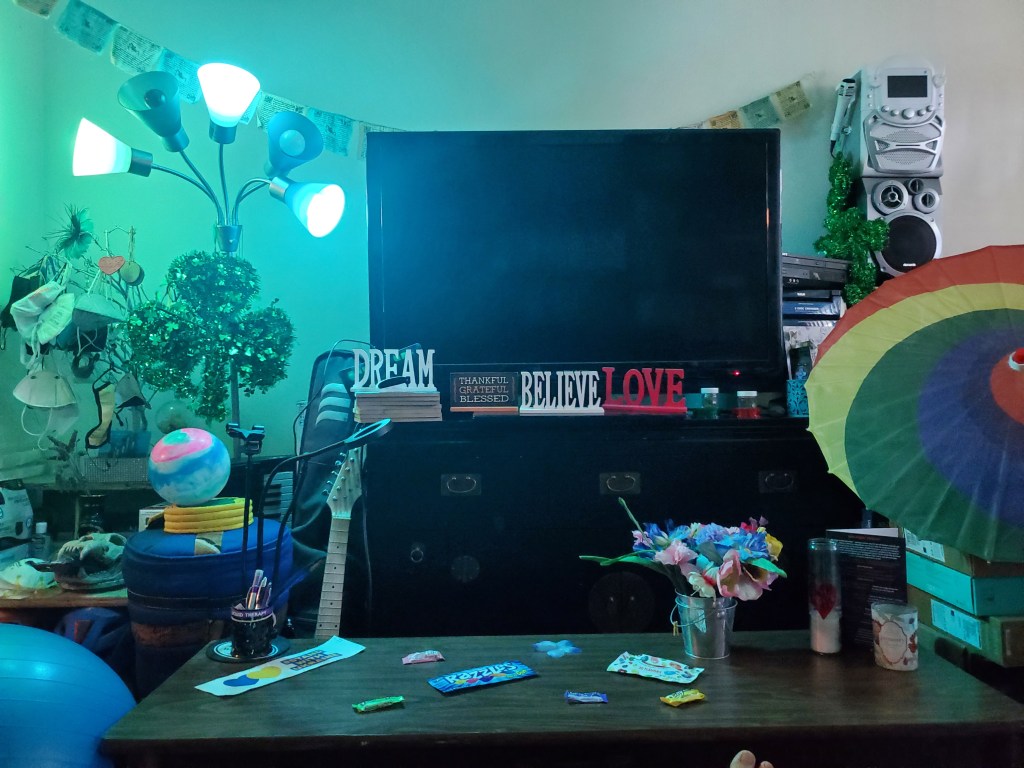
Following the call of a participatory approach to religious observance, I decided to throw a feast in honor of both Purim and St. Patty’s Day. I prepared 30 home-made hamentashen, a crock-pot of corned beef and cabbage, and a variety of libations. In the spirit of also observing a Jerusalem or Shushan Purim, I continued celebrating for another few days. I decorated my living room in the spirit of the festivities, all while simultaneously packing for an interstate move just two weeks away! I wanted to see our friends before we left, so I sent this “seudah shindig” flyer to about 40 people: 

Taking a closer look at the rhythm of religious observance, it is interesting to note Purim’s similarity to another debaucherous spring celebration – Mardi Gras. Rabbi Polish wrote that

“both of these celebrations are marked by a raucous atmosphere, the excessive consumption of intoxicants, masks and costumes and the transgression of even the most consequential social norms,” with both holidays serving as “the last eruption of self-indulgence before the prolonged period of self-denial leading up” to Passover and Easter, exactly one month later. 

Just like Purim, St. Patrick’s Day, and Mardi Gras seem to be life-affirming celebrations of a verdant Spring, the confluence of Passover and Lent/Easter appear to emphasize spiritual discipline and maybe even austerity. When Passover came in mid-April, I abstained from chametz for 8 days. Now, chametz is generally translated as leavened bread. The ritual descends from the Exodus story that the holiday is based on, when our ancestors needed to flee the authoritarian and homicidal Pharoah in Egypt and didn’t have time to let their bread rise. 

By the time Passover started, however, I was already halfway through Ramadan, which began on the Gregorian April 2. Because the Islamic calendar follows the moon’s revolution around the Earth, its holidays will cycle throughout the year, occurring approximately 10 days earlier every year. Both the Gregorian solar calendar and the Hebrew lunisolar calendar include leap years which prevent this phenomenon – so, although Jewish holidays fluctuate a few weeks every year, they always occur within the same season. Ramadan, however, will occur throughout the seasons if one zooms out enough decades. 

The observance of Ramadan is practiced during the month of Ramadan, the 9th month of the year. Ramadan almost feels like spiritual boot camp: priority toward praying, often in community, and allowing the space for Allah that would normally be occupied by our nefs (primal instincts). During this period, no food or drink is to be consumed after the fajr prayer or before the maghrib prayer, the times of which fluctuate througouth the year, but this year were about 4:30am and 7:30pm. So, for one month, I abstained (mostly) from eating and drinking for nearly 15 hours each day. Sex is also prohibited during these times. 

The word Ramadan derives from the Arabic root R-M-Ḍ (ر-م-ض) “scorching heat”, which is the Classical Arabic verb “ramiḍa (رَمِضَ)” meaning “to become intensely hot – become burning; become scorching; be blazing; be glowing”. The Hebrew word for the holiday Passover, חַג הַפֶּסַח, also has connotations of a sacrificial offering – so, between the two holidays, I had a lot at stake. I had already been abstaining from food generally from sunrise to sundown for a month, with 8 days in the middle requiring an additional foregoing of chametz when I did eat. I also had the fun challenge of needing to balance participating in the Passover seder with my family with stepping away for a few minutes to conduct the salat prayer at the time specified. 

Passover is ultimately about liberation. And you can imagine the immense sense of freedom that comes when it’s over and you can, once again, eat whatever you like. But this is ironic; it is actually Passover itself which is meant to symbolize liberation. Although there are plenty of possible ways to explain the liberation of restricting one’s practices, I would argue that simplifying one’s choices opens up more space for spiritual adherence. 

Ramadan has a very similar effect. I enjoyed not having to cook many meals for myself, simplifying my life and allowing more time for the 5 daily prayers. And then, when I finally had that glass of water or gluttonous (but not glutenous during Passover!) iftar feast, I was so filled with gratitude. And at the end of Ramadan, commemorated by the holiday Eid al-Fitr, I treated myself to breakfast at a fancy downtown cafe – my first breakfast in a month! Mindfulness around our consumption, which might increase our mindfulness more generally, inspires gratitude for what we do have. 

I’ll end on a sober note, writing this after a full year of reflection since the observances described. Through embracing multiple religious traditions, I do so with reverence for the spirit of the law for each, rather than any orthodox attachment to the letter of the law. Although I celebrated Purim/St. Patrick’s Day with alcohol, intoxicants are very seriously prohibited in Islam. I took liberties with my adherence to the religion throughout the year, but during Ramadan had no alcohol, using grape juice instead for the four cups of wine required during the Passover seder

In the last year, however, I decided that the prohibition of intoxicants in both Islam and Buddhism dwarfs the custom of drinking in Judaism (and general American culture), so both my Purim and my St. Patrick’s Day – this year 10 days apart – were dry. I still attended a purimspiel and made corned beef and cabbage, and honestly didn’t miss the libations one bit. Once again, however, Passover took place halfway into Ramadan (which both fell a week or so earlier than last year).

As this hadn’t happened for some time prior to last year and won’t happen again for many more years, I was excited to get one more shot at benefitting from the overlapping opportunities for spiritual discipline and liberation. Whereas last year I approached the confluence of holidays with a sense of awe and mystery for the divine timing (and in the middle of a big move), this year my experience was pretty uneventful. Rather than astronomical, the holidays were grounding. I’m reminded that, as we spiral once again through the same holiday cycles, we never know how they might affect us – the world is different than it was the year before, I am different.

“I Can’t Breathe”

I recently completed a 10-day course in Vipassana meditation at the Southern California Vipassana Center. This course is free for anyone that wants to participate, paid for by donations from others who have completed this same course. Although I have been practicing some form of meditation more-or-less consistently for almost 20 years, this experience of a silent 10 days in the desert was one of the most challenging times in my life; the most rigorous practice I’ve taken on. 

For 10 days, I would wake up to a bell at 4am in order to sit silently from 4:30am to 9:00pm, save for a few short meal breaks and an evening video recording of SN Goenka, the Burmese-Indian lay leader who taught Vipassana to thousands while alive and continues to do so posthumously. Goenka sought to teach the authentic path toward enlightenment as instructed by Siddhartha Gautama, Buddha, a practice which has often been lost or distorted due to historical and geographic ebb and flow. He often reiterates that this training is not meant to be sectarian, but universal – as it is a solution to the universal challenges we all face.

The foundation of this Vipassana practice is anapana: the observation of natural, normal respiration, as it comes in and as it goes out. Sustained anapana is taught exclusively for the first few days of the 10-day period, in order to calm and concentrate the mind. Goenka emphasizes in audio and video recordings that this is not a practice in pranayama, by which some sort of regulation of breath occurs – rather the breath must be observed, as it is

At some point along the path of anapana during this retreat, I realized that I had a hard time distinguishing between the breath as it is and some regulated version that I was subconsciously facilitating. About ten years ago, I realized that I could attain deep belly-expanding breaths all the time if I maintained some sort of exercise every day. The benefit of this discipline has been well-worth the effort. Since then, I have not missed more than a day or two of exercise. I have become so used to taking deep steady breaths all the time, that I had forgotten what it could be like to not have this access to expanded respiration. 

Without a cardio practice in the desert, however, my breaths became more and more shallow. At one point, when I most resolved myself to just experience the natural breath without trying to change it, it became so shallow that I felt as if I were drowning. It reminded me of my first job after college – in the days before my daily cardio routine, when I would feel this way on the drive to work. I remember feeling like I couldn’t catch a full breath; it would subside after some time, but was a distinct feeling I hadn’t had very often since then.

As I sat on my cushion to meditate, my increasingly shallow breathing was soon accompanied by a racing heart and sweaty palms. Soon my stomach was wrenching. It struck me: “This is what anxiety feels like”. I realized that my exercise routine was one of my central methods of dealing with anxiety – so well that I never had fully experienced this before. Here, on day 7 of my retreat, I allowed my experience to arise without attempting to control it. As a result, I was flooded with a feeling of anxiety that I came to know all too well in a matter of moments. My breath became more and more disconnected, and then the thought came:

“I Can’t Breathe”. 

“I can’t breathe” is a statement that has almost come to characterize our epoch. 

Although perhaps most widely known as being gasped by George Floyd as the world watched him being choked by Derrick Chauvin for 9 minutes, the New York Times reported that the phrase has been used by over 70 people who died in police custody. We might remember these words also being the last ones on the lips of Eric Garner, an unarmed man who was killed in 2014 after being put in a chokehold by a New York City Police Officer. Then Javier Ambler, Manuel Ellis, Elijah McClain. Perhaps for each of the Black men who said or thought “I can’t breathe” as they lay choking at the hands of those paid to serve and protect, millions more struggle to breathe preemptively, their inhale-exhale strangled by the anxiety of simply driving a car, jogging down the street, or wearing a hoodie. 

Clearly, this last year-and-a-half has been characterized by “I Can’t Breathe” as COVID-19 has attacked the respiratory systems of over 200 million people across the world. Nigerian novelist and poet Ben Okri wrote in The Guardian article “‘I can’t breathe’: why George Floyd’s words reverberate around the world” “that the consonance of the phrase with the very root of our pandemic fears is uncanny. The phrase linked the coronavirus with the ubiquitous and implacable nature of institutional racism”. 

Doubly troubling is the appropriation of “I can’t breathe” by right-wing reactionaries, personified by Arizona City Councilman Guy Phillips while he took off his mask at a rally protesting the mandatory mask wearing announced by Scottsdale Mayor Jim Lane. Anti-mask protesters have continued to disgrace the original ethos of this phrase throughout the pandemic, including chants by those who stormed the Capitol on January 6. 

My experience of breath-defying panic attack at the Vipassana retreat, feeling like I was drowning in my own air, led me to wonder if there is even more to the collective recent experiences of “I Can’t Breathe”. While few peoples’ breathing is actually obstructed by wearing a mask, perhaps those anti-mask protestors are experiencing shallow breathing as a function of subconscious anxiety, likely rooted in the social injustices they so fervently champion. Our symptoms are often more complex than we realize – and likely point to deeper truths.

As James Hillman and Michael Ventura inquired in We’ve Had a Hundred Years of Psychotherapy and the World’s Getting Worse (1992), rather than understanding one’s depression or anxiety (solely) as a disorder related to an individual’s past traumas, what if we look for the genesis of the symptom in the present and in the worldly realm? Perhaps we are depressed because of the thick layer of smog hovering over our home or we are anxious because of the hungry and impoverished masses just on the other side of the freeway. 

According to Hillman, what if “the depression we’re all trying to avoid could very well be a prolonged chronic reaction to what we’ve been doing to the world, a mourning and grieving for what we’re doing to nature and to cities and to whole peoples [ …]  We awaken daily in fear of the things we live with, eat, drink, and breathe.”

With this larger context in mind, it’s no wonder that in the face of chronic toxic stress so many of us are in a perpetual state of “fight or flight”. What is more formally called the sympathetic nervous system, a necessary bodily function when we’re facing a ferocious lion in the wilderness, leaves us with the profuse sweating, rapid heartbeat and short breaths we associate with stress – even in times of relative societal calm. Yet, amidst our chaotic times, this stress response – out of sync with what the situation actually calls for – becomes pathological, increasing harm and division, and limiting our depth and breadth. 

Swan Song of the White Ego, Part 2: Return of the Barbarian

“A relation with any archetype involves the danger of possession, usually marked by inflation” – James Hillman (1967) . These words have been ringing in my ears since the failed coup on the Capitol on January 6th, 2021.

In June, amidst the Black Lives Matter protests, I wrote an article called “Swan Song of the White Ego”. I never meant to imply that the end of whiteness would happen any time soon. Rather, I intended to draw attention to Trump’s presidency and the increasing presence of vocal white supremacists in our midst as the increase in symptoms that often occurs before an underlying root illness improves. Obviously, the pinnacle of this dynamic was the attempted seizure of the Capitol building by the pro-Trump white supremacist militia contingent. I want to return to this idea in the context of that incident – in order to hopefully offer a little more insight. 

Depth psychologist Carl Jung observed in the 1920s that the “Germanic people” had a “problematic and dangerously close relation to the barbarian,” a barbarian which was let loose less than a decade later as the “‘blond beast’ of National Socialism” (cited in David Tacey’s Edge of the Sacred). German society at the time can be characterized by its emphasis on culture and civilization. Freud may have described this as a sublimation of the “id”, our animal instincts – sex drives and aggression. In classical Freudian parlance, the German superego had suppressed, rather than integrated, the id. Jung noticed the barbarian lurking in the collective shadow.

Regardless of psychological abstractions, the Germans had privileged their Christian heritage over their pagan roots, and the warrior god Wotan would return with a vengeance. Within a decade or two after Jung’s writing, the Germans annihilated six million Jews, as well as a motley crew of Roma, political and religious dissidents, homosexuals, “impure” ethnicities, and people with disabilities. 

We might understand the German campaign to exterminate these populations as scapegoating. Silvia Brinton Perera wrote about the “scapegoat complex,” explaining that a particular group is “identified with evil or wrong-doing, blamed for it, and cast out from the community in order to leave the remaining members with a feeling of guiltlessness, atoned (at-one) with the collective standards of behavior”. Rather than change the systems and structures that cause injustice – in Germany’s case, the devastating impact of their loss in World War I – scapegoating rejects individuals or groups of people, sustaining the imbalance of one’s own group.

For centuries, of course, the white imagination in the United States (and across the globe) identified itself with being civilized – while scapegoating people of color as slaves and savages. While it may be easy to assume that this has changed in full due to a relative increase in access by some people of color, the year 2020 has dashed many of our post-racial (and naive) hopes: the overaggressive response of law enforcement to the nonviolent civil disobedience of the Black Lives Matter protests compared to the relative docility officers showed Trump supporters as they smashed windows and assaulted others in the Capitol building. 

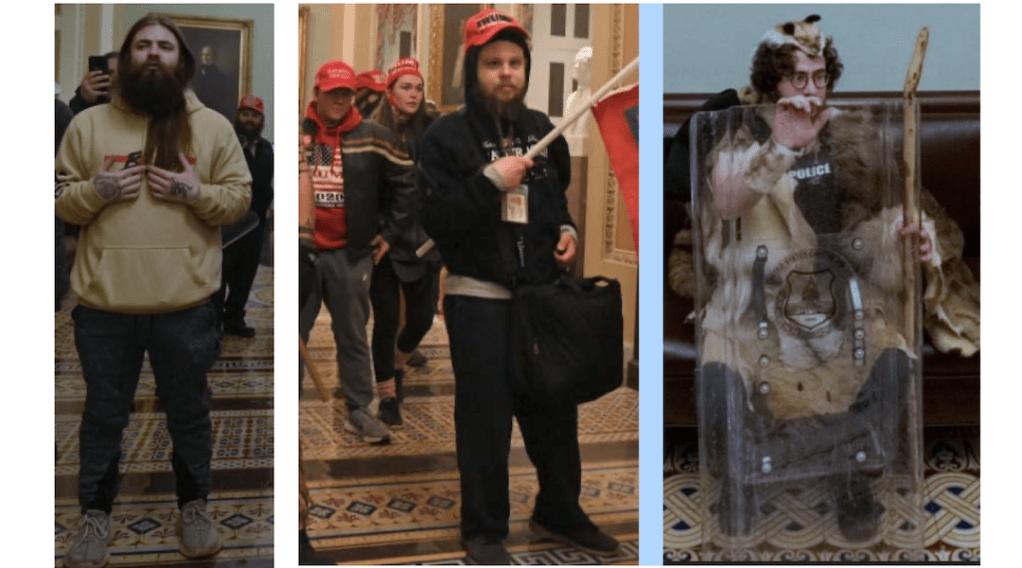
It is, in fact, this image that piqued my interest in writing about this topic – the way in which the myth of the civilized white was tarnished in one day. One might think of the now infamous Jake Angeli, dubbed QAnon Shaman, with his fur and face paint. While it’s certainly troubling that this man appears to be appropriating indigenous imagery, it points to the possession by the barbarian archetype. While we may consider the value of individuals of European descent getting connected to their own indigenous traditions, it is clear that Angeli’s relationship to Wotan is a pathological one. It is worth noting, by the way, that the etymology of the Norse name Wotan/Odin is “leader of the possessed”.

Although Angeli’s photo has become ubiquitous, I chose the photo above because it is one of my fellow Jews, Aaron Mostofsky, referred to in New York Magazine as the Capitol Riot ‘Caveman’ From Brooklyn. It is simultaneously striking, confusing, and disappointing that an Orthodox Jew would join together with white supremacists – and yet this (mis)alignment has not been uncommon in the Trump era. I believe it speaks to both the allure of complicity with the collective white ego, as well as the vast disturbance we are faced with when we project the barbarian. We might even trace this dynamic (in part) to the Judeo-Christian tradition of defaming the rugged hunter Esau while privileging the supposedly civilized Jacob – despite the fact that it was the latter who was most guilty of savagery. This splitting off of Esau arguably echoes until today. As Rabbi Rami Shapiro wrote in his gem of a book on a Jewish reclaiming of the “Deep Masculine,” we must embrace Esau. To not do so is to fall prey to the unconscious barbarian within us.

We might consider that a relatively healthy association with the barbarian, perhaps a more conscious relationship to that archetype, can occur through spending time in the wilderness – or even the face paint worn by fans at a sporting event. An unconscious relationship, as the Hillman quote above refers, involves the danger of possession. Inflation might be thought of as the belief that we are godlike: “we can take over the Capitol!” An unhealthy and unconscious relationship to this archetype becomes an attack on what society holds sacred; not only waving your flag, but using it to beat your enemy. It is self-destructive.

As with the Germans who projected their inner barbarian onto those they slaughtered (calling them vermin and subhumans), chickens come home to roost. The American myth of the rebel is tearing apart this nation. As a teenage anarchist and activist, I always saw myself as a rebel. But I’ve very obediently been following the public health mandate to wear a mask for the past 10 months – along with many others who identify as politically progressive. Meanwhile, blind allegiance to “independence” (and to the charlatan who occupied the White House for four years) has so many (white) Americans clinging to their guns and eschewing the one thing that would keep them safe. This ethos is perhaps best characterized by South Park’s Cartman, in his very American insistence: “I do what I want”.

With the storming of the Capitol by “American rebels,” the white ego was aflame – the very same day that we saw a black man and a Jewish man elected to the Georgia senate. Events at two extreme poles: one, the success of multiracial democracy in the South; simultaneously, white supremacists raging against their fear that their way of life is slipping away. Perhaps they are right; post-election, this country is moving in a new direction. It’s clear from the decidedly multicultural events from last week’s inaugural proceedings – including a phenomenal interfaith Presidential Prayer Service. In the light of this possibility, for the first time in four years, I can say that I am proud to be an American. But, still, there is shadow…

My claim about the white ego’s swan song is less descriptive than prescriptive. We are not free and clear yet. We must continue to forge multicultural democracy – investing in initiatives around race, class, and the other -isms at the root of both historical oppression and the white ego’s self-justifications. But we must also take into consideration our relationship with the barbarian. We cannot continue to be possessed by its lure: suppressing, projecting, and annihilating the other. Instead, we must adopt a conscious relationship to the barbarian, as part of the wholesale reconciliation that must occur in response to centuries of domination by the collective white ego.

Dreaming into the New Year

The New Year tends to give us a glimpse of utopia, a time to imagine that this next year will be a good one; whatever the trials and tribulations of the past, this next round will bring redemption. That seems to ring especially true as we transition from 2020 to 2021 – from a year where the whole world was afflicted by a pandemic to one that has a light at the end of the tunnel: a vaccine, a new U.S. president, and – hopefully – a real commitment to address the injustices and challenges that were ignored or exacerbated over the last few years. 

For me personally, 2021 is poised to be special. I hope to get married, maybe buy a home; my career is in transition in a way that encompasses my greatest ambitions; I have some writing projects in the works… 

For now, however, I want to set aside my relatively small hopes for 2021 – perhaps big for me personally, yet blips on the screen projected onto community, let alone Earth.  

Instead of being focused on the practical moves forward in 2021, of which there are sure to be plenty, I want to really run with the metaphor of New Year as Utopia. Perhaps, in 2021, everything is possible. 

Nothing says this better than the poem “The First Week” by Laura Eberly. I’ll return to this poem shortly. But first, I want to zoom in and out a little bit more. I remember first discovering this poem in the first weeks of the pandemic, at a time when – despite the tremendous uncertainty and fear of the impending coronavirus – people took advantage of the municipal stay-at-home orders and spent multiple days in their pajamas, baking, and reading, and hopefully cuddling. 

Now, of course this image of those early weeks of the pandemic glosses over the real experience of essential workers, those living check-to-check, and those whose home lives are filled with contention. It assumes the ability to keep money in the bank, perhaps the ability to take off work for weeks at a time or at least to work from home; the potential to care for one’s children full-time and maintain all of the other responsibilities of adulthood; that home life can be peaceful and vibrant.

Many never got to enjoy this temporary and extended “snow day” – and it is essential (pun intended) to keep all these folks in mind. Others got to enjoy it for a time, but then had to get back to their hustle somehow, despite the restrictions of the pandemic, in order to maintain their livelihoods. There are also those who potentially could have continued to experience an extended period of hibernation, but became bored and ill-at-ease and have decided to prematurely return to “business as usual”, cavalierly associating with others and causing infection rates and deaths to skyrocket. 

I have been blessed during quarantine and truly grateful for my blessings. I was able to work from home and then pretty seamlessly transitioned to a new, better opportunity in the middle of 2020. I have had an exceptionally lovely time with my partner of 12 years, with whom I’ve thoroughly enjoyed being in quarantine. We got engaged during the pandemic and are patiently waiting the green light from public health officials after which we’ll plan a gathering to celebrate marriage. 

For years, Kimeiko and I have noticed that the winter months are meant for hibernation – if one follows the seasons and their natural rhythms – and have been all but appalled to see the extent to which our Western society puts our materialism on hyperdrive at the time we ought to be most withdrawn. We have therefore mostly related to these last 9 months as a year-long (and maybe a little more) period of hibernation, after which we will once again socialize regularly and carry on with our lives. 

Of special interest to me over the last few months, a topic about which I wrote more extensively in my article Juneteenth and a New Jubilee, has been the Jewish concept of Shmita – a year-long period every seven years in which people abstain from business-as-usual, and, in particular, let the land rest. The pandemic has intimated the potential of Shmita – particularly the early months where more people observed the stay-at-home orders, businesses mostly stopped, and our greenhouse emissions were drastically reduced (although still not nearly enough). 

As some of us have gotten a taste of what Shmita might be like, my interest in the concept as a sociopolitical intervention is energized. Rabbi Michael Lerner suggested we “imagine the human race taking off one year out of every seven”, with the “15 percent who had to run essential services” getting a “rotating sabbatical” the other six years. One implication is the possibility that if we followed this law (albeit in an updated manner appropriate to the 20th century), we could avoid the universe forcing us to follow it due to the effects of natural disasters and pandemics. 

I believe that all cultures and wisdom traditions have something to offer the collective. One of the key gifts of Judaism to the world is Shabbat and Shmita. The biblically-determined Shmita year begins in about 9 months and some in the Jewish world are asking what it will take for us to collectively observe this ritual in a way that truly protects the natural world and allows us to deepen into the retreat from materialism that we dipped our toes into this past March. For example, the Jewish environmental organization Hazon has developed a campaign around it called the Shmita Project. Its core message is to “Reimagine society”.

In this spirit of utopianism and the dream of a true collective hibernation – not because a pandemic has forced it but because it is what we truly need – I offer this poem to start off 2021. 

It is both a wink toward what 2021 could look like and, even more so, a nod toward what the first day of Shmita could be – not as an exclusive Jewish practice but as a multicultural collective adoption in the spirit of mutual aid, spiritual sacrifice, and tending to the soul of the natural world – so that we may rest and restore balance.

I have taken some creative license in adapting this poem to begin on Friday, January 1. I hope that if Ms. Eberly happens across this blog that she will appreciate my small changes and consider them a blessing on her original, which is truly perfect already. Ultimately, this poem invites us to imagine snapping our fingers and waking up to days we could only dream of…

“The First Week” by Laura Eberly
(edits by Pesach Chananiah)

On the first day of this New Year,
we will be too busy
healing, tending, and child-rearing
for waging war,
so the soldiers will have no orders.
The police will have quiet radios and no calls,
so we will tear apart the prisons
and send the guards to rehab,
where first-graders and nursery workers will teach them slowly
to trust humanity again,
beginning with their own.
We will use the bricks and fences
to build community centers with wide porches
where the grannies can knit and keep watch instead.

Saturday would be for rest:
hammocks,
creeks,
and lemonade.
We would listen to the earth
and the spirits
and our ancestors
and our lovers
and our beloveds
and the bullfrogs
and the songbirds
and the tall grass
and the redwoods
and the oak trees

breathing

          for one day

every week.
Breathing.

On Sunday
we should assemble all the healers –
all the yogis, chiropractors, sangomas, and sage smudgers –
and ask them to have coffee with the matriarchs,
and the refugees,
and the trans sex workers,
and the small town queers,
and anybody who has yelled at a marble building through a bullhorn,
or raised a child in times of war,
and by lunchtime all of us would learn
to locate, heal, and fortify our spines.

If we all agreed to,
on Monday
we could plant a pollinator garden on every corner
and turn over one parking spot per block
to vegetables and fruit.
That evening,
the musicians would find our diaphragms
and teach us new songs
to sing while planting.

On Tuesday
after the gardens,
we would repair every roof,
install rain barrels and solar panels,
retrieve the lost balls and frisbees and kites,
and remember we are tiny beneath the sky.

On Wednesday,
we’d fix the heaters
so the gas could never be cut off,
and install a tiny lead filter in every faucet.

By Thursday,
we would know each others’ names
and begin to tell our stories.
Then
the farmers and the roofers and the plumbers
would be honored by the lawyers and the doctors,
who had spent their first week ever listening.
Next, venerations and reparations
by the bankers and professors,
who will learn that education isn’t learning
and money isn’t value
and nothing is the feel of soil in your hands
or throwing back your head to sing.
We will ache for love and owning nothing
and for the first time
that will make us unafraid.

As we reach Friday once again, we heal and tend and prepare for rest once again.
And by next Sunday,
we would know who else we need.

My Brother’s Keeper

In the Jewish world this Saturday, everyone began the Torah from the beginning, reading Genesis 1:1-6:8. For those unfamiliar, this portion of the Bible – called “Bereshit” for the first words, “In the Beginning” – is a lot of material, covering everything from the Creation of the World to the tale of Adam and Eve up until the very beginning of the story of Noah and the Ark. 

Tucked in the middle, Chapter 4 is the story of Cain and Abel – which I didn’t really ever read until today. When I saw my Rabbi and the 13-year-old who became a bar mitzvah share their learning from this Torah portion over Facebook Live, I thought I would read the story for myself – and then take a crack at writing about it and how the images and metaphors it conjures might have some resonance and message for current events. 

An important note, before I continue, is that I don’t actually have training in Biblical hermeneutics and I am not especially aware of the various Biblical commentaries by rabbis and theologians over the years. I am reading this story as a layperson, yet through the lens of a depth psychologist, whose training is in part to find potentially valuable associations between the myths that undergird our societies and the sociocultural realities they circumscribe. 

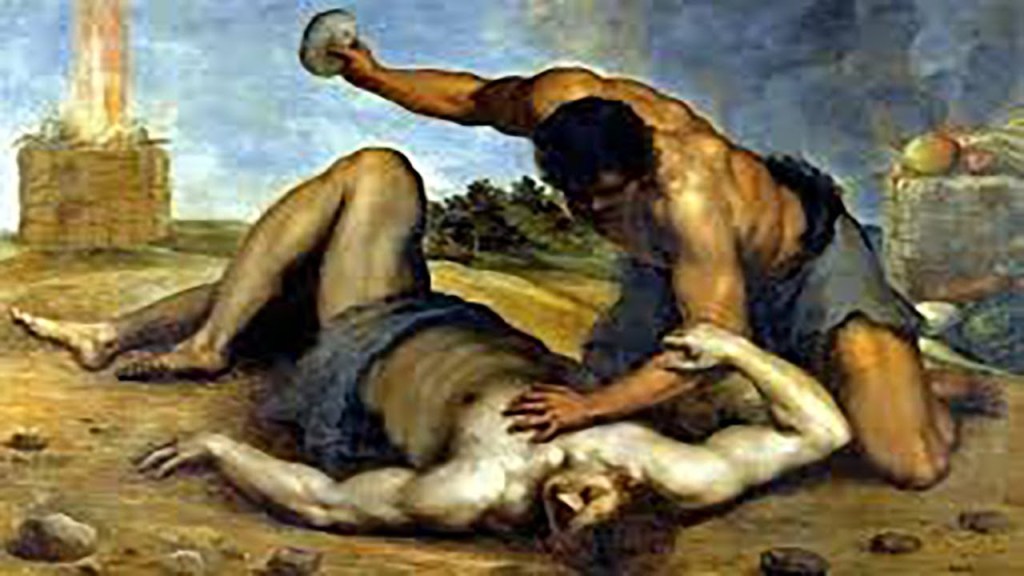
What happens in the story of Cain and Abel (Genesis 4:2-5) is that Abel, a “keeper of sheep” gives to Yehovah the “firstlings of his flock,” while Cain, a “tiller of the soil”, brought as an offering the “fruit of the soil”. Now, at the time, this carnivorous deity clearly preferred animal sacrifice to a vegan diet and so he only “paid heed” to the shepherd and not to the farmer. Apparently, Cain became jealous of the attention his brother received and committed the first fratricide. 

The wonderful sermon by yesterday’s Bar Mitzvah boy suggested that G-d had made a mistake by privileging one son over the other. Fair point. He also inquired into judging someone not for their acts but seeking to understand the potentially complicated motivations behind those acts. What really got me thinking, however, was his simple question: “Why did Cain kill Abel?”

My automatic and perhaps most obvious answer: well, apparently he forgot he was his brother. Genesis 4:9: “The LORD said to Cain, ‘Where is your brother Abel?’ And he said, ‘I do not know. Am I my brother’s keeper?”

He played dumb. It is amazing, if unfathomable, how often we forget that we are each others’ siblings. I’ve spent hours upon hours of time volunteering for transformative courses made up of 150-200 participants, and seen how common it is that siblings alienate each other. In fact, one of the biggest, and often first and foremost, “breakthroughs” people can achieve in these courses (see Landmark Worldwide) is reconciliation with family members! It also often alters other aspects of their lives.

More profoundly, and I know there probably isn’t a way to say this without sounding hokey or trite, but we have ALL forgotten that we are each others’ siblings. This concept is understandably met with cynicism and suspicion, as fused as it is with “color blind”, “kumbaya”, and the infamous “all lives matter”. 

And yet, if we can give up that cynicism, and explore our true kinship and common humanity, we get to the place where: if all children were seen as your children, would you assent to locking them in cages? If all men were your brother, could you put your knee on their neck? If all women were your sister, could you rape them? 

We later learn in this story (4:20-22) that Cain’s descendants were Jabal, the ancestor of those who dwell in tents and amidst herds; Jubal, the ancestor of all who play the lyre and the pipe; and Tubal-cain, who forged all implements of copper and iron. Ostensibly, they spawned all the archetypes known under the sun. 

But what of the descendants that would have been possible from Abel’s DNA? What is missing from the world that would have been present had Abel been allowed to live and procreate? Or, more presently: what would Michael Brown have accomplished – and his children? Or 17-year-old Antwon Rose? Or 15-year-old Jordan Edwards? 

The Washington Post just published a podcast titled The Life of George Floyd, asserting that while he has “become a symbol, and a rallying cry,” “what’s missing in our understanding is the man himself: a figure who was complicated, full of ambition, shaped by his family and his community and a century of forces around him.” 

It starts with Floyd sending a message that the shooting stops. We must always wonder, at 46 years old, what might George Floyd have been able to accomplish had he had another 30, 40, or 50 more years?! 

To return briefly to our myth, God then banishes Cain to be a “ceaseless wanderer” as punishment. When Cain expresses his fear that anyone might kill him, Yehovah promises “sevenfold vengeance” on anyone that kills Cain – and puts “a mark on Cain, lest anyone who met him should kill him.” His descendent Lamech even has the gall to “have slain a man for wounding me, And a lad for bruising me” – but “if Cain is avenged sevenfold, then Lamech seventy-sevenfold.”

The line of Cain is therefore reminiscent of our modern police force that can slay someone for wounding or bruising them and yet be free of God’s wrath. The hubris! But perhaps police somehow “bear the mark of Cain”. [A small irony in the Netflix series Lucifer, which I wrote about recently, is that the police lieutenant in Season 3 turns out to be Cain from Genesis 4!] The fact of the matter is that they’re certainly not treating “a perp” like a brother. Race (or some other bias) all too often gets in the way of a shared realization of common humanity. 

I heard from my rabbi recently that we might actually live whatever Torah is read in the synagogue (or outside the synagogue!) that week. This week then, perhaps we keep reminding ourselves that no matter what happens between us and our neighbor, that we are ultimately kinfolk at heart. When God asks us to account for ourselves or an Other, we answer not with feigned ignorance like Cain – hoping to escape accountability. 

Rather, what if we speak in the affirmative about being our brother’s keeper? What might it be like to answer the (clearly moral as well as geographic) call of “where are you?” like the upcoming characters Abraham (Genesis 22:1), Jacob (Genesis 31:11), and Moses (Exodus 3:4)? They respond to God or His angels as we also might, with an assertion of responsibility: “Hineini”, “I am here”; I am present for my fellow human beings, for my siblings, as we work together to improve our shared planet. 

Repairing Broken Glass

How often poetry and pun intersect with prophecy.

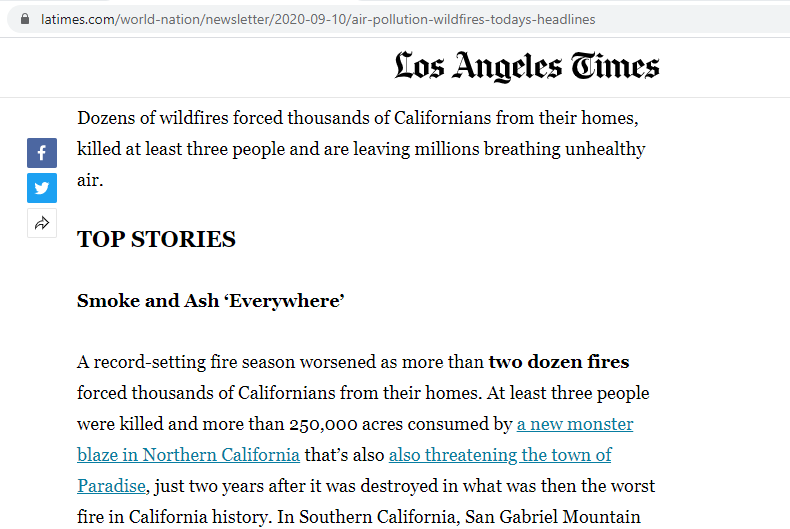
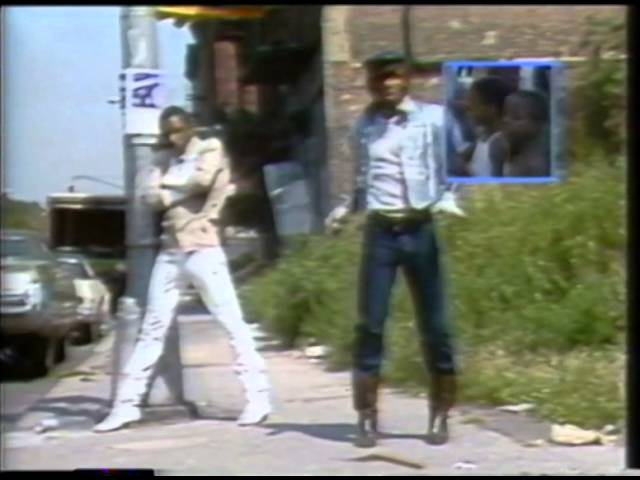
This past week, while scanning my daily email from the Los Angeles Times, I chuckled at Thursday’s headline: “Smoke and Ash ‘Everywhere'”. I couldn’t not hear the line that any rap fan worth their weight in a fat gold chain would know. The chorus for Grandmaster Flash and the Furious Five’s “The Message” starts out: “It’s like a jungle sometimes/ It makes me wonder how I keep from goin’ under” and then the verse starts: “Broken glass everywhere “. “Broken Glass” === “Smoke and Ash”. Just brilliant!

I found this headline so humorous – despite the incredibly concerning content about two dozen California fires – that I had to share it with a few friends. One wondered if the rhyme/pun was intentional (maybe?) – and another wrote: “I can hear that lyric in my head now. Those fires are terrible”.

The song, lauded over the years for its innovative instrumentation, has been sampled by Ice Cube and Puffy, and influenced countless of other songs and artists. According to a little research I did for this blog post, it also apparently foregrounded the MC for the first time in rap history, as opposed to the previous privileging of the DJ – permanently altering the art form. It was also apparently the first prominent hip hop song to provide a social commentary, paving the way for everything from conscious hip-hop to gangsta rap. More the latter than the former, unfortunately, due to the song’s fatalism (as opposed to hope) – which I’ll return to.

The irony in this metaphorical languaging became clear as I spoke to the Chair of a synagogue’s Green Action Team about how often his rabbi talks about climate change and other ecological concerns. He responded “Not enough – but one year for our High Holy Day services, she iterated the urgency of climate change, comparing it to broken windows theory”.

Of course, Broken Windows Theory refers to the 1982 article in The Atlantic Monthly by Kelling and Wilson which poses the following: if a building has a few broken windows, the tendency is for people to have less respect for the building, break more windows, then break into the buildings and eventually trash the neighborhood. Therefore, according to the theory, it is necessary to fix the windows before the situation gets out of hand. At first glance, this theory makes a lot of sense. Certainly, fixing windows in a neighborhood – and other clean-up initiatives – would probably contribute to the respect its given.

And yet, for decades, this theory has been used to enact draconian law enforcement policies. One of its authors, Rutgers criminologist George Kelling, was brought to Los Angeles by his protégé Police Chief William Bratton to advise around the City’s homelessness policy. They hold that punishing lesser offenses leads to reductions in major crimes. Following Kelling’s theory, and his own practices from working at NYPD, Bratton instituted increased arrests against so-called “quality of life criminals,” in an effort to curb the bigger crimes they supposedly lead to. And, rather than house the unhoused, Bratton criminalized sitting on the sidewalk and began to arrest homeless people for…well, being homeless.

Thankfully, over the last 15 years, the American Civil Liberties Union and other organizations advocating for Skid Row residents have fought this practice in the courts. Still, the metaphor of “cleaning up the neighborhood” resonates.

So let’s go back to our song lyric for a moment. “Broken glass everywhere” leads into Melle Mel rapping: “People pissin’ on the stairs, you know they just don’t care/ I can’t take the smell, can’t take the noise/ Got no money to move out, I guess I got no choice”. There is a deep fatalism in that last line: “I guess I got no choice”; this is just how it is. I get the enormity of social problems – but someone committed to a community can always try to fix broken windows rather than move out or give up.

Which brings us back to the rabbi preaching about climate change. I can only guess what she spoke about – probably the need to focus on our actions, our metaphorical “breaking of windows”, that lead to the planetary slum we’re apparently creating. We’ve watched more and more fires rage over these last few years, and despite good-natured (and somewhat impactful) personal choices to minimize carbon footprints, by most counts we only have a matter of decades before things get really bad.

To offer just one more metaphor: our environmental crises have been like the frog in boiling water. The climate is getting hotter and hotter and we haven’t noticed – we haven’t yet jumped out of the pot. We’ve watched the gradual downward spiral of how we treat the planet and, by-and-large, thrown our hands up like Melle Mel. But with these fires raging yet again, we must wonder when we’ll have had enough.

Smoke and ash “everywhere” is another broken window. How many more do we need to see – how many people “pissin’ on the stairs” before we respond. After these last few years of increasing natural disasters, resulting from climate change, it’s time for our little froggy faces to start asking: “how do we get out of this pot?”

In the Jewish world, we’re headed to the High Holy Days this week – a time to “turn” anything that must be turned. To do teshuvah, “return”. My rabbi preached the other day that until our very last breath, there’s always an opportunity to return. No matter how bad things get, there’s always hope. There’s a moment where we must say: “No more. I’ll sweep the glass off the concrete. I’ll put in a new window”.

“I’ll do tikkun“, to use the other relevant Hebrew word here, “repair”. This is our tikkun for this time. We must repair whatever needs to be mended: “I’ll fight for renewable energy – I’ll change my life as much as I need to – until all the climate scientists finally give a favorable prognosis”. What might it look like to tend to our world, to repair it? To attend to our broken glass and repair whatever is needed before this neighborhood called the planet becomes the block in “The Message”?

The Myth About the Police

I’m thinking about myth. Now, in a sense, you could say I am a doctor of myth: my training in psychology has been to use myth as a lens for understanding dreams, symptoms, and psyche. Much of that training has been an attempt to apply myth, symbol, and symptom to our current epoch – in an effort to better understand the interventions or responses to the health of communities, systems, and institutions. 

Contrary to popular parlance, “myth” for me does not simply mean “not true” ; rather, our myths are the stories that enact powerful resonance on how we live our lives. One can see, for example, the way that the stories we hear most growing up tend to give direction to what we see is possible. As myth and media become more and more conflated in our present society (all those memes!), I’m mulling over the relation between the two in this current moment. 

I’ve recently been infatuated with the Netflix series Lucifer, an obsurd scenario in which the devil becomes a sexy British human who owns a nightclub in Los Angeles and moonlights as a detective consultant, solving murders and punishing evil. He’s visited over the 5 seasons by angels, demons, Cain, and Eve. While I enjoy the buddy-cop suspense and campy humor, I’m also fascinated with the way that various Biblical myths are applied to modern scenarios. 

But the reason I’m thinking about myth in Lucifer, at least for this blog post, is not for all the powerful Biblical imagery and metaphor. It is the realization of how prevalent, in the United States and perhaps other places, is the myth of the “cop”. We have so many sitcoms and films about police that we “know” so much more about how the police operate by our media, than we have any accurate sense of the reality. At least until the camera phone.

Despite the focus on police solving murders, in shows like Law & Order and Blue Bloods and my new favorite Lucifer, it turns out that surprisingly few police hours actually get spent on this arguably important function. Asher and Horwitz wrote in a recent New York Times article that the share of policing “devoted to handling violent crime is very small, about 4 percent.” In the real world, a “lucky” cop will get to pursue a serious case like this once a year – and if it happens twice, they’re celebrated as “Police of the Year”. Clearly, much of the work of police goes to other things. 

One of the elements of the media-caused myth of police is the chase scene. We consumers get to be on the edge of our seats. As they leap over walls and cars, swoop around corners, we wonder: are they going to catch him? If they do, it’s sometimes an easy arrest; sometimes the pursued actually attempts to fight the pursuers; and, often times, whoever is arrested turns out to be completely innocent. But, by the end of the episode, the “bad guy” is caught. 

Yet I can’t think of (almost) any police show where the cop says “he’s too fast and too far. I’ll just shoot him from behind”, shoots the suspect in the back, and “suspect” immediately becomes “victim”. I can’t quite fathom a scenario in a TV show where the cop simply says (forgive my harsh language but I couldn’t imagine otherwise): “Oh well, just another bum / addict / ni**er dead. Let’s go grab a coffee”.

The absurdity of this scene in a show becomes even more painful when compared to the reality I imagine for the hours that immediately followed those* who murdered George Floyd. Did those four officers grab lunch? Kiss their wives? Talk about what they did? They just committed a murder. But on our televisions, the police are the heroes.

How little life and art imitate each other in this case. The extent to which our reality and our (media-derived) myth are disconnected is troubling. And so, another black man – Jacob Blake – was shot in the back, from behind, by those paid by tax dollars to “serve and protect”. Somehow still unfathomable. One of the questions this begs is: what is a new myth for this area of American life?

There is more and more in our media (in large part, our social media) that attests to the reality of the police system – and sheds light on its disconnections from our myth of the police. From When They See Us and The Hate U Give to Spike Lee’s See You Yesterday. While these examples certainly speak the truth about police in this country, they aren’t quite myth. And myth is important – stories are important – because they give us a framework, a context, hopefully on which to base reality. 

I also just recently saw HBO original mini-series Watchmen. What a brilliant and powerful, while at times troubling, story. SPOILER ALERT: this show does a great job of critiquing the police myth, making a large percentage of police double as white supremacist terrorists (Yikes!), but also having a few of the police double as superheroes. Now, I don’t know that we necessarily need a myth where the heroes are played by law enforcement – I guess that’s been part of the problem. So I’m not saying that Watchmen is a perfect substitute for all the other stuff. But, in a world where our myths of police are so incredibly out of alignment with the reality, we need to create a new myth that both takes into account the reality, but also develops some new possibilities for it. 

* may they burn in whatever hell exists when their time comes

Juneteenth and a New Jubilee

Over the past few weeks, I’ve been thinking about the last class I taught in a year-long Jewish studies course for 8th and 9th graders. I felt like the learning we did and what the students got out of it was striking and worth sharing about. Yet, I waited to share because I didn’t see how it was relevant to what our country is experiencing (and it feels disrespectful to be irreverent in that way) – until now. On June 19th, the anniversary of the union army’s 1865 proclamation that all slaves in Texas were free, this topic is particularly pertinent. I’ll share our learning and then why it matters. 

After a year of “indoctrinating” my students into my particular brand of Judaism – getting advice from trees on Tu b’Shvat (“Jewish Arbor Day”), dreamwork when discussing the story of Jacob, and fire meditation for Lag b’Omer – we covered what might be the most radical Torah portion, which has the most incredible relevance to our current epoch. At our last class, which focused on the revelation Moses received on Mount Sinai, we looked closely at the incredibly profound message of the passages Behar and Behukotai. In this Torah portion, the practice of shmita is introduced. Shmita is like a 7-year sabbath: not only should individuals work for 6 days and then rest every 7 days, but they are also supposed to work the land every 6 years and then let the land rest on the 7th year. No sowing seeds – a break from domination. Additionally, in this 7th year, all debts are released

Incidentally, I had noticed some conversation in our media recently about this practice. On March 21, economics professor and author of “… and forgive them their debts” Michael Hudson advocated in the Washington Post for a  “debt write-down” as a way to keep our economy afloat. In the first weeks of coronavirus quarantine, he suggested that the “outbreak is serving as a mind-expansion exercise, making hitherto unthinkable solutions thinkable. Debts that can’t be paid won’t be. A debt jubilee may be the best way out”. Just a few weeks after Hudson, John Nichols wrote in The Nation about the UK-based Jubilee Debt Campaign which demands the immediate cancellation of debt payments for the poorest countries, which would “free up resources to tackle the urgent health, social and economic crises resulting from the Covid-19 global pandemic”. While jubilee – which we will come to in a moment – is a different phenomenon from shmita in the bible, it makes sense that these authors use an English term (rather than a Hebrew one) in our current context. 

Now, while the bible offers shmita as a model of debt release every 7 years, the jubilee (yovel in Hebrew) is actually supposed to occur every 7×7 years, meaning every 50th. During this time, ancestral holdings of land are returned. And slaves are set free. Not to rationalize the slavery of the time (from our modern moral vantage point, any slavery = bad), but it was somewhat different than the slavery that existed in the Americas over the last half a millennium. The slavery mentioned in the Torah is not a chattel slavery based on white supremacy and generational trauma. Rather, the text goes into detail as to how slaves could free themselves; could pay for their redemption. If they did not free themselves, however, “if he has not been redeemed in any of those ways,” it says in Leviticus 25: 54, “he and his children with him shall go free in the jubilee year”. Every fifty years, social relations with various levels of inequality would return to 0, to the beginning again. Starting fresh.

This year, Juneteenth’s celebration of liberation feels even more strikingly pertinent, as we as a country reckon with the legacy of slavery and centuries of inequality made manifest particularly by the police system’s inequitable meting out of justice. After 500 years of slavery on this continent, the generational wealth gap between whites and blacks reverberates in all types of ways. Whereas the slavery of ancient times was likely pretty gruesome in some ways, a returning of land and liberation every 50 years ensured that no one could be so exceptionally wealthy to the detriment of others. This was a stop gap of the 1%. Perhaps it is time to return to this ancient effort to equalize. 

And yet the laws of shmita and yovel – which we might depict in this present time as one phenomenon of Jubilee – are not all that is read one Shabbat morning by Jews across the world in this paired parshah (this year, it was about a month ago). The second, perhaps even more striking, Torah portion that comes on the heels of Behar is Behukotai. Here, Moses relayed: “if you follow [G-d’s] laws, [He] will grant your rains in their season, so that the earth shall yield its produce and the trees of the field their fruit”. In other words, fertility and abundance and peace occur. HOWEVER, if you reject and spurn G-d’s rules and break the covenant, “your strength shall be spent to no purpose. Your land shall not yield its produce, nor shall the trees of the land yield their fruit”. 

Importantly, it is spelled out in the next line that: “Then shall the land make up for its sabbath years throughout the time that it is desolate […]; then shall the land rest and make up for its sabbath years.” I started to inquire into this concept since our coronavirus quarantine time began. As a world community, we have been in constant overdrive to produce, reap, and sow; never resting or letting our land rest. Since we have all been forced to dwell indoors, it has been pervasive in news stories worldwide that the land has been getting a chance to regenerate; and, hopefully, we have rested in our communities, as well. 

I call this “Jewish karma” – not to connote that there is a divine tally of reward and punishment, but that our heritage which is derived out of agricultural seasons and cyclical rhythms points to a need for alignment with these rhythms. When we are sufficiently out of alignment, I believe, the earth shakes us back into place.

I shared this possibility with my students, unsure if they would get the punchline. Thankfully, it really resonated. They certainly got that the Torah, which perhaps all year was somewhat removed from their lives, has ancient wisdom for modern times. Most importantly, this class drove home the specific realization that our pandemic might have more method than the apparent madness; maybe there is meaning to discover in tough times, and our traditions can help to uncover it.

The earth may be shaking us into alignment with its needs; but there is more work to be done for us to re-align with each other. As my students discovered, our ancient wisdom has modern relevance. Technologies of time which liberate people, land, and resources are not unprecedented. After weeks of protest in response to militaristic racialized violence, it seems that it is not only the coronavirus which, as Hudson wrote, makes “hitherto unthinkable solutions thinkable”. The zeitgeist of our time has opened up possibility and there is work to be done – perhaps so that, one day, our work will be complete and we can finally rest.

Swan Song of the White Ego

Over the last week, I’ve been grappling with how best to contribute – amidst appropriate grief (for what exactly, I’m not quite sure yet) and gratitude that (white) people are finally waking up. I realize that my perspective as a Community-oriented Depth-Psychologist is a unique one – a viewpoint that I believe will shed some light on our current events. The following is my attempt to apply a study of soul (“psyche-ology,” etymologically speaking) to the present situation, and offer something instructive to my white peers. 

Depth psychology, the study of the unconscious, was popularized at the turn of the 20th century by the famous Sigmund Freud. My training, in particular, is based on the teachings of his protege Carl Jung – a man who has given us concepts like archetype, complex, and shadow. At the root of depth psychology is an approach which includes dream, metaphor, and image – and the symptoms which derive from a psychological state which is ill at ease. My work has been to apply these concepts to not only individuals but to groups, organizations, and communities – including the systems, practices, and ideas that they have constructed. 

First, a little about some psychological terms –  and then an application to society and the moment we’re in. Freud’s structures of consciousness – id, ego, and superego – do not exist in any sort of objective, material way. Of course, they do not show up under a microscope or in an autopsy. Like many concepts, they act as distinctions, allowing us to see through a perspective that illuminates what we would not otherwise be able to see. In Freud’s formulation, the “id” is characterized by our animal instincts – primarily sex drives and aggression. Applied to the level of society, id might be thought of as the force that causes war – that cannot be contained by the civilizing force of the superego.

What Freud called the “superego” is generally our internalized collective conscience determined by cultural prescriptions. When our superego is contradicted by experience, one result is “shadow projection”: the stereotype of “lazy” for black and Latino men – while the white supervisor gets to sit in the shade, repressing the obvious reality. Another effect of superego is guilt when actions don’t align with proscriptions or expectations. We might think of guilt at the level of culture: white guilt, for example, in the face of failing to live up to values of equality and freedom.

Ego mediates between the id and the superego and, as such, is the general structure of consciousness that we rely on daily. Contrary to New Age parlance, “ego” is not a bad thing. It is necessary; the house of our executive function. In fact, what is usually characterized (negatively) as the voice of “ego” is more likely exemplified by the urges and demands of id or superego. The job of the ego is to both override and integrate the impulses of the id and superego – to accept information or experiences which demand that it change in various ways. In this way, the ego ought to be like bamboo: sturdy, yet flexible. My ego must have the structural strength to resist killing or rape; and must be agile enough to adapt when I learn from others that I have acted in a way that has negatively impacted them.

What is problematic, and what I think ancient Eastern and modern spiritual sources are getting at when they critique ego, is an inflated ego – self-righteousness and self-importance, mixed with lack of connection to others. It is also problematic to possess an alienated ego, feeling exceptionally small and disconnected in the face of personal and communal challenges. Oftentimes, inflation and alienation of ego are two sides of the same coin. A number of years ago, when I was dealing with some personal struggles – and ultimately sought the help of a therapist – I had to confront the reality that my ego structure was both too fragile and too rigid. 

Which brings me to our discussion of the ego as a collective phenomenon. Many of us are familiar with the concept, per Robin DiAngelo, of white fragility – which, I assert, is intimately related to white rigidity. This is demonstrated by the defensive response to “Black Lives Matter” of “All Lives Matter”! Just as the ego is attacked, it tends to batten down the hatches. This is seen quite literally when Donald Trump – perhaps the most striking symptom of the inflated/alienated white ego – called in the cavalry, by having the National Guard and police forces suppress dissent. 

In developing a healthy relationship to ego myself, I have found the work of scholar Robert Shedinger instructive. Shedinger argues that our current tendency is to invent “impermeably bounded [ego] identities in order to buffer us from the dizzying uncertainty contained in the big questions of life”. Our families and communities, generally wanting us to have safe and comfortable lives, feel completely confident in telling us: “you are a Christian (or Muslim or Jew)”, “you are a boy” or “girl”, “you are black” or “white”. While these identities in and of themselves might be harmless, it can be dangerous to society when our egos become reified, if not ossified. 

Shedinger argued that, instead, ego ought to be “provisional”. To be provisional is to be “for now”; willing to be some other way at a later date. Not attached to “the way I am”. To be psychologically healthy in the present moment is to be malleable – not in the sense that we should adapt to social constructs, but that we can transform in response to insights and actions. Most importantly, we must allow ourselves to be altered by difference, influenced by the Other – allowing a new Ego to emerge. 

I am clear that we are called to a societal evolution. The coexisting challenges of pandemic + awakening to police brutality and pervasive racism are not disconnected. We are at a time when the symptoms of societal dis-ease are being brought to light. We have been abusing the planet, other creatures, and our fellow human. This has been caused, in large part, because of the (rigid) identities that we have: human vs. earth, black vs. white, top of the food chain vs. every other creature. This is our illness. Everything else is symptom. The work to do is to let ourselves be impacted. When people ask: “what can I do?”, the answer might be to protest. In fact, this is necessary. It is also necessary to learn, read, discuss. But those are still insufficient. Ultimately, what there is to do is to be influenced by the Other. To let ourselves – our ego structures – be transformed. The work is to evolve the collective ego and this, of course, requires us all to be like bamboo.

Shedinger, in his text Radically Open , encourages us to “willingly give up restrictive provisional identities and submit to a higher power that they neither fully understand nor control and that may require of them more than they are willing to give”. For those of us who benefit from white privilege, we must sacrifice. This means both: to give something up and to make sacred. We must give up our privilege, our blindness to injustice, our rigidity of collective selfishness. We MUST allow our collective ego to be broken open – open to a new collective ego that is more integrative of difference. And we must also make sacred the lives of those who are not-white, the land on which we have “settled”(colonized), and the ultimate aim of truly living in a multicultural democracy where ALL are included. 

Three Faces of Soul

I dedicate this article to Shaykh Dr. Ibrahim Abdurrahman Farajajé (peace be upon him), who was a Judeo-Islamic inspiration.

As I watch the sun set on this beautiful Friday, I am present to the nearness of the Jewish sabbath day of rest – as well as to the last day of the Muslim holiday of Ramadan. To my Jewish brethren, Shabbat Shalom. To those for whom G-d is One and Muhammad is his prophet, a late Ramadan Kareem and an early Eid Mubarak. 

I was raised Jewish and continue to have a vibrant connection to Jewish heritage and practices. AND for a number of years, I have taken on a Muslim practice as well. I love what Yossi Klein Halevi said about praying with Muslims, that he “found their way of expressing devotion somehow familiar. The prostration in surrender to God was once a mode of prayer in Judaism [and ] joining the Muslim prayer line helped reconnect me to my ancient roots”. This feels true for me – Muslim practice not only as a way to connect with “the Other”, but to my own ancestry as well. 

This Ramadan marks my 7th year observing that very holy and special, yet trying and disciplining, month. I’m remembering my first Ramadan, sitting on the carpet of a masjid in Berkeley and listening to the Imam during jumma – as he spoke of Ramadan as an opportunity to master one’s nafs. I understood through the context that this was apparently the word for our instincts and desires: the hunger, thirst, and sexual relations that practicing the Ramadan fast allows us to maintain command of. Although I hadn’t heard this Arabic word before, it was clearly a cognate of the Hebrew nefesh, one of three words for soul in the Jewish tradition. 

As a depth psychologist, I have taken seriously the etymology of my field as “study of soul”. This is not “soul” in the sense of something tangible or a metaphysical reality, but a perspective. The early psychologists seemed to be clear about this – before the mainstream discipline attempted to accommodate itself to a medical model based on positivism and pragmatism. And while the psychological orientation to soul is quite different from a dogmatic religious approach, I am nevertheless interested in the way that spiritual traditions attempt to characterize those parts of us which are elusive and ethereal but which might be described as “soul” or “spirit”. 

So I’d like to share a little bit about how the Judeo-Islamic traditions talk about soul. I will not be taking a very orthodox approach and those who do might consider me a heretic. I will admit that my knowledge on this topic is autodidactic,accompanied by Wikipedia searches. As a depth psychologist, I am interested in these topics as metaphor and, therefore, am interested more in exploration than exactitude. 

As I mentioned above, I first learned that nafs is one’s animal nature, akin to what Freud called the id. This makes sense in Hebrew, as well, where nefesh is the aspect of soul most closely related to the body and the physical plane. What is most fascinating to me is that, upon further study, I understand nafs to be used in the Quran for both individual and collective purposes – similar to the way that we in psychology use the word psyche to describe one’s individual soul as well as the world soul. 

The second level of soul in the Jewish understanding is ruach, meaning wind. It is also used, colloquially, to describe exuberance or energy. In the Quran ruh is used to describe the spirit that animates the inanimate – and is also the word for “angel”. Ruach and ruh are considered to be higher levels of soul – perhaps what distinguishes humans from other creatures. As far as I can tell, Islam maintains just the two levels of soul: nafs and ruh.

In some places, Judaism discusses 5 types of soul – but I will refer to just the main three. The last level of soul in the Jewish system is neshamah. While all three terms – nefesh, ruach, and neshamah – have to do with the breath, neshamah is literally and etymologically related to the word “breath”. I have read that nefesh is exhale while neshamah is inhale – inspiration. According to holy scriptures, the human soul came from Spirit breathing into the human body. For me, what’s most important is not what language we use to describe the ineffable or whether we identify as those who wrestle with the divine or those who submit (as humans, I believe we fluctuate between the two), but to remember that we are all made from the same image.