I recently completed a 10-day course in Vipassana meditation at the Southern California Vipassana Center. This course is free for anyone that wants to participate, paid for by donations from others who have completed this same course. Although I have been practicing some form of meditation more-or-less consistently for almost 20 years, this experience of a silent 10 days in the desert was one of the most challenging times in my life; the most rigorous practice I’ve taken on.
For 10 days, I would wake up to a bell at 4am in order to sit silently from 4:30am to 9:00pm, save for a few short meal breaks and an evening video recording of SN Goenka, the Burmese-Indian lay leader who taught Vipassana to thousands while alive and continues to do so posthumously. Goenka sought to teach the authentic path toward enlightenment as instructed by Siddhartha Gautama, Buddha, a practice which has often been lost or distorted due to historical and geographic ebb and flow. He often reiterates that this training is not meant to be sectarian, but universal – as it is a solution to the universal challenges we all face.
The foundation of this Vipassana practice is anapana: the observation of natural, normal respiration, as it comes in and as it goes out. Sustained anapana is taught exclusively for the first few days of the 10-day period, in order to calm and concentrate the mind. Goenka emphasizes in audio and video recordings that this is not a practice in pranayama, by which some sort of regulation of breath occurs – rather the breath must be observed, as it is.
At some point along the path of anapana during this retreat, I realized that I had a hard time distinguishing between the breath as it is and some regulated version that I was subconsciously facilitating. About ten years ago, I realized that I could attain deep belly-expanding breaths all the time if I maintained some sort of exercise every day. The benefit of this discipline has been well-worth the effort. Since then, I have not missed more than a day or two of exercise. I have become so used to taking deep steady breaths all the time, that I had forgotten what it could be like to not have this access to expanded respiration.
Without a cardio practice in the desert, however, my breaths became more and more shallow. At one point, when I most resolved myself to just experience the natural breath without trying to change it, it became so shallow that I felt as if I were drowning. It reminded me of my first job after college – in the days before my daily cardio routine, when I would feel this way on the drive to work. I remember feeling like I couldn’t catch a full breath; it would subside after some time, but was a distinct feeling I hadn’t had very often since then.
As I sat on my cushion to meditate, my increasingly shallow breathing was soon accompanied by a racing heart and sweaty palms. Soon my stomach was wrenching. It struck me: “This is what anxiety feels like”. I realized that my exercise routine was one of my central methods of dealing with anxiety – so well that I never had fully experienced this before. Here, on day 7 of my retreat, I allowed my experience to arise without attempting to control it. As a result, I was flooded with a feeling of anxiety that I came to know all too well in a matter of moments. My breath became more and more disconnected, and then the thought came:
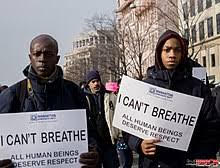
“I Can’t Breathe”.
“I can’t breathe” is a statement that has almost come to characterize our epoch.
Although perhaps most widely known as being gasped by George Floyd as the world watched him being choked by Derrick Chauvin for 9 minutes, the New York Times reported that the phrase has been used by over 70 people who died in police custody. We might remember these words also being the last ones on the lips of Eric Garner, an unarmed man who was killed in 2014 after being put in a chokehold by a New York City Police Officer. Then Javier Ambler, Manuel Ellis, Elijah McClain. Perhaps for each of the Black men who said or thought “I can’t breathe” as they lay choking at the hands of those paid to serve and protect, millions more struggle to breathe preemptively, their inhale-exhale strangled by the anxiety of simply driving a car, jogging down the street, or wearing a hoodie.
Clearly, this last year-and-a-half has been characterized by “I Can’t Breathe” as COVID-19 has attacked the respiratory systems of over 200 million people across the world. Nigerian novelist and poet Ben Okri wrote in The Guardian article “‘I can’t breathe’: why George Floyd’s words reverberate around the world” “that the consonance of the phrase with the very root of our pandemic fears is uncanny. The phrase linked the coronavirus with the ubiquitous and implacable nature of institutional racism”.
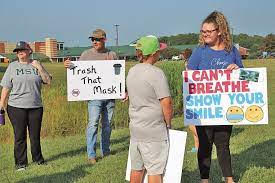
Doubly troubling is the appropriation of “I can’t breathe” by right-wing reactionaries, personified by Arizona City Councilman Guy Phillips while he took off his mask at a rally protesting the mandatory mask wearing announced by Scottsdale Mayor Jim Lane. Anti-mask protesters have continued to disgrace the original ethos of this phrase throughout the pandemic, including chants by those who stormed the Capitol on January 6.
My experience of breath-defying panic attack at the Vipassana retreat, feeling like I was drowning in my own air, led me to wonder if there is even more to the collective recent experiences of “I Can’t Breathe”. While few peoples’ breathing is actually obstructed by wearing a mask, perhaps those anti-mask protestors are experiencing shallow breathing as a function of subconscious anxiety, likely rooted in the social injustices they so fervently champion. Our symptoms are often more complex than we realize – and likely point to deeper truths.
As James Hillman and Michael Ventura inquired in We’ve Had a Hundred Years of Psychotherapy and the World’s Getting Worse (1992), rather than understanding one’s depression or anxiety (solely) as a disorder related to an individual’s past traumas, what if we look for the genesis of the symptom in the present and in the worldly realm? Perhaps we are depressed because of the thick layer of smog hovering over our home or we are anxious because of the hungry and impoverished masses just on the other side of the freeway.
According to Hillman, what if “the depression we’re all trying to avoid could very well be a prolonged chronic reaction to what we’ve been doing to the world, a mourning and grieving for what we’re doing to nature and to cities and to whole peoples [ …] We awaken daily in fear of the things we live with, eat, drink, and breathe.”
With this larger context in mind, it’s no wonder that in the face of chronic toxic stress so many of us are in a perpetual state of “fight or flight”. What is more formally called the sympathetic nervous system, a necessary bodily function when we’re facing a ferocious lion in the wilderness, leaves us with the profuse sweating, rapid heartbeat and short breaths we associate with stress – even in times of relative societal calm. Yet, amidst our chaotic times, this stress response – out of sync with what the situation actually calls for – becomes pathological, increasing harm and division, and limiting our depth and breadth.
 Community Alchemist