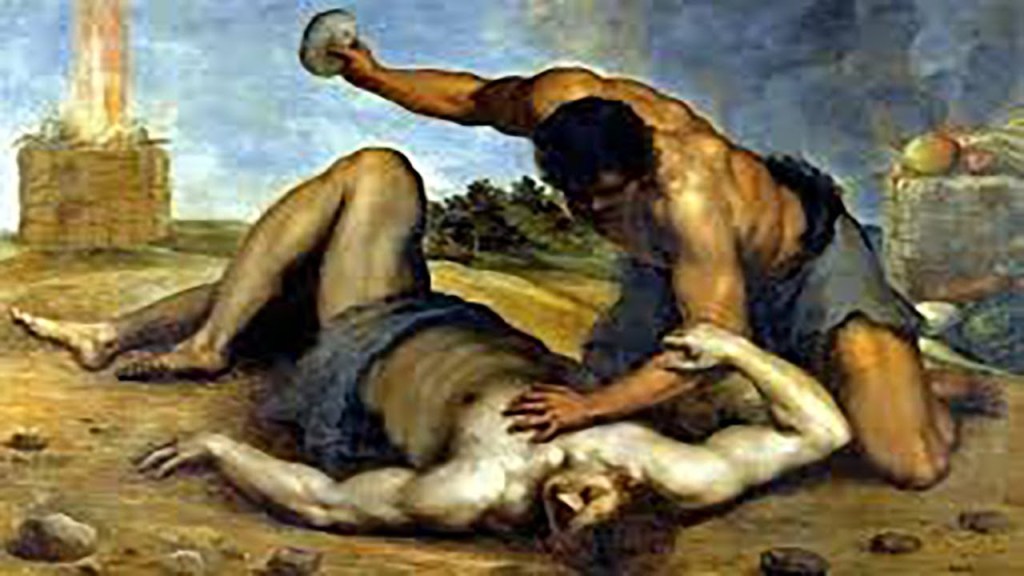
In the Jewish world this Saturday, everyone began the Torah from the beginning, reading Genesis 1:1-6:8. For those unfamiliar, this portion of the Bible – called “Bereshit” for the first words, “In the Beginning” – is a lot of material, covering everything from the Creation of the World to the tale of Adam and Eve up until the very beginning of the story of Noah and the Ark.
Tucked in the middle, Chapter 4 is the story of Cain and Abel – which I didn’t really ever read until today. When I saw my Rabbi and the 13-year-old who became a bar mitzvah share their learning from this Torah portion over Facebook Live, I thought I would read the story for myself – and then take a crack at writing about it and how the images and metaphors it conjures might have some resonance and message for current events.
An important note, before I continue, is that I don’t actually have training in Biblical hermeneutics and I am not especially aware of the various Biblical commentaries by rabbis and theologians over the years. I am reading this story as a layperson, yet through the lens of a depth psychologist, whose training is in part to find potentially valuable associations between the myths that undergird our societies and the sociocultural realities they circumscribe.
What happens in the story of Cain and Abel (Genesis 4:2-5) is that Abel, a “keeper of sheep” gives to Yehovah the “firstlings of his flock,” while Cain, a “tiller of the soil”, brought as an offering the “fruit of the soil”. Now, at the time, this carnivorous deity clearly preferred animal sacrifice to a vegan diet and so he only “paid heed” to the shepherd and not to the farmer. Apparently, Cain became jealous of the attention his brother received and committed the first fratricide.
The wonderful sermon by yesterday’s Bar Mitzvah boy suggested that G-d had made a mistake by privileging one son over the other. Fair point. He also inquired into judging someone not for their acts but seeking to understand the potentially complicated motivations behind those acts. What really got me thinking, however, was his simple question: “Why did Cain kill Abel?”
My automatic and perhaps most obvious answer: well, apparently he forgot he was his brother. Genesis 4:9: “The LORD said to Cain, ‘Where is your brother Abel?’ And he said, ‘I do not know. Am I my brother’s keeper?”
He played dumb. It is amazing, if unfathomable, how often we forget that we are each others’ siblings. I’ve spent hours upon hours of time volunteering for transformative courses made up of 150-200 participants, and seen how common it is that siblings alienate each other. In fact, one of the biggest, and often first and foremost, “breakthroughs” people can achieve in these courses (see Landmark Worldwide) is reconciliation with family members! It also often alters other aspects of their lives.
More profoundly, and I know there probably isn’t a way to say this without sounding hokey or trite, but we have ALL forgotten that we are each others’ siblings. This concept is understandably met with cynicism and suspicion, as fused as it is with “color blind”, “kumbaya”, and the infamous “all lives matter”.
And yet, if we can give up that cynicism, and explore our true kinship and common humanity, we get to the place where: if all children were seen as your children, would you assent to locking them in cages? If all men were your brother, could you put your knee on their neck? If all women were your sister, could you rape them?
We later learn in this story (4:20-22) that Cain’s descendants were Jabal, the ancestor of those who dwell in tents and amidst herds; Jubal, the ancestor of all who play the lyre and the pipe; and Tubal-cain, who forged all implements of copper and iron. Ostensibly, they spawned all the archetypes known under the sun.
But what of the descendants that would have been possible from Abel’s DNA? What is missing from the world that would have been present had Abel been allowed to live and procreate? Or, more presently: what would Michael Brown have accomplished – and his children? Or 17-year-old Antwon Rose? Or 15-year-old Jordan Edwards?
The Washington Post just published a podcast titled The Life of George Floyd, asserting that while he has “become a symbol, and a rallying cry,” “what’s missing in our understanding is the man himself: a figure who was complicated, full of ambition, shaped by his family and his community and a century of forces around him.”
It starts with Floyd sending a message that the shooting stops. We must always wonder, at 46 years old, what might George Floyd have been able to accomplish had he had another 30, 40, or 50 more years?!
To return briefly to our myth, God then banishes Cain to be a “ceaseless wanderer” as punishment. When Cain expresses his fear that anyone might kill him, Yehovah promises “sevenfold vengeance” on anyone that kills Cain – and puts “a mark on Cain, lest anyone who met him should kill him.” His descendent Lamech even has the gall to “have slain a man for wounding me, And a lad for bruising me” – but “if Cain is avenged sevenfold, then Lamech seventy-sevenfold.”
The line of Cain is therefore reminiscent of our modern police force that can slay someone for wounding or bruising them and yet be free of God’s wrath. The hubris! But perhaps police somehow “bear the mark of Cain”. [A small irony in the Netflix series Lucifer, which I wrote about recently, is that the police lieutenant in Season 3 turns out to be Cain from Genesis 4!] The fact of the matter is that they’re certainly not treating “a perp” like a brother. Race (or some other bias) all too often gets in the way of a shared realization of common humanity.
I heard from my rabbi recently that we might actually live whatever Torah is read in the synagogue (or outside the synagogue!) that week. This week then, perhaps we keep reminding ourselves that no matter what happens between us and our neighbor, that we are ultimately kinfolk at heart. When God asks us to account for ourselves or an Other, we answer not with feigned ignorance like Cain – hoping to escape accountability.
Rather, what if we speak in the affirmative about being our brother’s keeper? What might it be like to answer the (clearly moral as well as geographic) call of “where are you?” like the upcoming characters Abraham (Genesis 22:1), Jacob (Genesis 31:11), and Moses (Exodus 3:4)? They respond to God or His angels as we also might, with an assertion of responsibility: “Hineini”, “I am here”; I am present for my fellow human beings, for my siblings, as we work together to improve our shared planet.
 Community Alchemist