Over the last week, I’ve been grappling with how best to contribute – amidst appropriate grief (for what exactly, I’m not quite sure yet) and gratitude that (white) people are finally waking up. I realize that my perspective as a Community-oriented Depth-Psychologist is a unique one – a viewpoint that I believe will shed some light on our current events. The following is my attempt to apply a study of soul (“psyche-ology,” etymologically speaking) to the present situation, and offer something instructive to my white peers.
Depth psychology, the study of the unconscious, was popularized at the turn of the 20th century by the famous Sigmund Freud. My training, in particular, is based on the teachings of his protege Carl Jung – a man who has given us concepts like archetype, complex, and shadow. At the root of depth psychology is an approach which includes dream, metaphor, and image – and the symptoms which derive from a psychological state which is ill at ease. My work has been to apply these concepts to not only individuals but to groups, organizations, and communities – including the systems, practices, and ideas that they have constructed.
First, a little about some psychological terms – and then an application to society and the moment we’re in. Freud’s structures of consciousness – id, ego, and superego – do not exist in any sort of objective, material way. Of course, they do not show up under a microscope or in an autopsy. Like many concepts, they act as distinctions, allowing us to see through a perspective that illuminates what we would not otherwise be able to see. In Freud’s formulation, the “id” is characterized by our animal instincts – primarily sex drives and aggression. Applied to the level of society, id might be thought of as the force that causes war – that cannot be contained by the civilizing force of the superego.
What Freud called the “superego” is generally our internalized collective conscience determined by cultural prescriptions. When our superego is contradicted by experience, one result is “shadow projection”: the stereotype of “lazy” for black and Latino men – while the white supervisor gets to sit in the shade, repressing the obvious reality. Another effect of superego is guilt when actions don’t align with proscriptions or expectations. We might think of guilt at the level of culture: white guilt, for example, in the face of failing to live up to values of equality and freedom.
Ego mediates between the id and the superego and, as such, is the general structure of consciousness that we rely on daily. Contrary to New Age parlance, “ego” is not a bad thing. It is necessary; the house of our executive function. In fact, what is usually characterized (negatively) as the voice of “ego” is more likely exemplified by the urges and demands of id or superego. The job of the ego is to both override and integrate the impulses of the id and superego – to accept information or experiences which demand that it change in various ways. In this way, the ego ought to be like bamboo: sturdy, yet flexible. My ego must have the structural strength to resist killing or rape; and must be agile enough to adapt when I learn from others that I have acted in a way that has negatively impacted them.
What is problematic, and what I think ancient Eastern and modern spiritual sources are getting at when they critique ego, is an inflated ego – self-righteousness and self-importance, mixed with lack of connection to others. It is also problematic to possess an alienated ego, feeling exceptionally small and disconnected in the face of personal and communal challenges. Oftentimes, inflation and alienation of ego are two sides of the same coin. A number of years ago, when I was dealing with some personal struggles – and ultimately sought the help of a therapist – I had to confront the reality that my ego structure was both too fragile and too rigid.
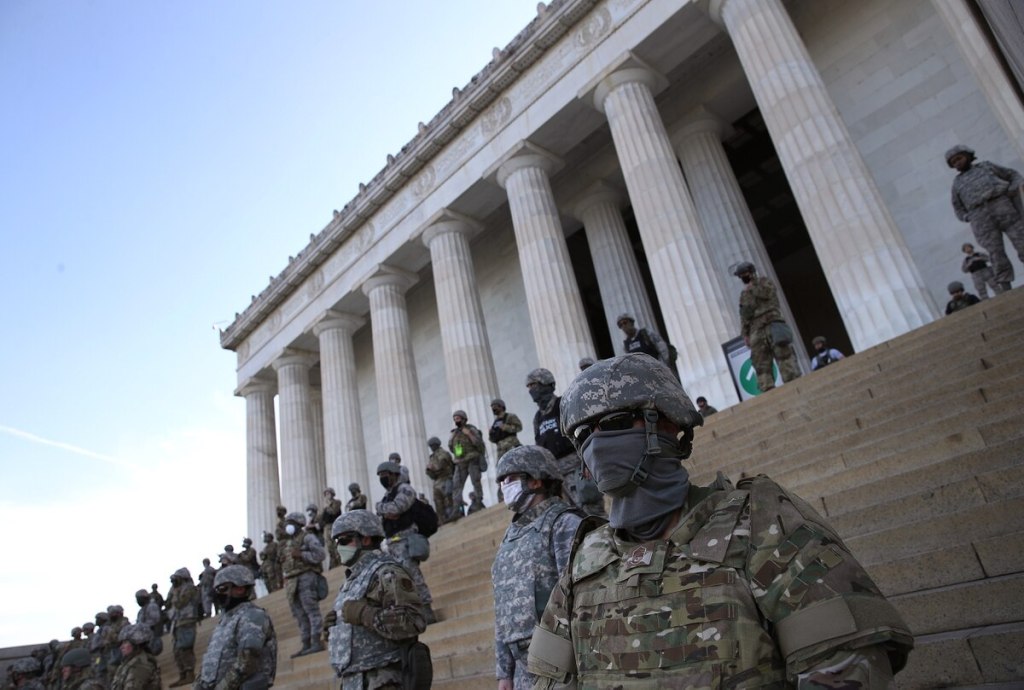
Which brings me to our discussion of the ego as a collective phenomenon. Many of us are familiar with the concept, per Robin DiAngelo, of white fragility – which, I assert, is intimately related to white rigidity. This is demonstrated by the defensive response to “Black Lives Matter” of “All Lives Matter”! Just as the ego is attacked, it tends to batten down the hatches. This is seen quite literally when Donald Trump – perhaps the most striking symptom of the inflated/alienated white ego – called in the cavalry, by having the National Guard and police forces suppress dissent.
In developing a healthy relationship to ego myself, I have found the work of scholar Robert Shedinger instructive. Shedinger argues that our current tendency is to invent “impermeably bounded [ego] identities in order to buffer us from the dizzying uncertainty contained in the big questions of life”. Our families and communities, generally wanting us to have safe and comfortable lives, feel completely confident in telling us: “you are a Christian (or Muslim or Jew)”, “you are a boy” or “girl”, “you are black” or “white”. While these identities in and of themselves might be harmless, it can be dangerous to society when our egos become reified, if not ossified.
Shedinger argued that, instead, ego ought to be “provisional”. To be provisional is to be “for now”; willing to be some other way at a later date. Not attached to “the way I am”. To be psychologically healthy in the present moment is to be malleable – not in the sense that we should adapt to social constructs, but that we can transform in response to insights and actions. Most importantly, we must allow ourselves to be altered by difference, influenced by the Other – allowing a new Ego to emerge.
I am clear that we are called to a societal evolution. The coexisting challenges of pandemic + awakening to police brutality and pervasive racism are not disconnected. We are at a time when the symptoms of societal dis-ease are being brought to light. We have been abusing the planet, other creatures, and our fellow human. This has been caused, in large part, because of the (rigid) identities that we have: human vs. earth, black vs. white, top of the food chain vs. every other creature. This is our illness. Everything else is symptom. The work to do is to let ourselves be impacted. When people ask: “what can I do?”, the answer might be to protest. In fact, this is necessary. It is also necessary to learn, read, discuss. But those are still insufficient. Ultimately, what there is to do is to be influenced by the Other. To let ourselves – our ego structures – be transformed. The work is to evolve the collective ego and this, of course, requires us all to be like bamboo.
Shedinger, in his text Radically Open , encourages us to “willingly give up restrictive provisional identities and submit to a higher power that they neither fully understand nor control and that may require of them more than they are willing to give”. For those of us who benefit from white privilege, we must sacrifice. This means both: to give something up and to make sacred. We must give up our privilege, our blindness to injustice, our rigidity of collective selfishness. We MUST allow our collective ego to be broken open – open to a new collective ego that is more integrative of difference. And we must also make sacred the lives of those who are not-white, the land on which we have “settled”(colonized), and the ultimate aim of truly living in a multicultural democracy where ALL are included.
 Community Alchemist
One thought on “Swan Song of the White Ego”
Comments are closed.